
Help Centre › Stock & pricing
Protocols
Bundle the items that always go together — a spay, a dental, a vaccination — into one line the vet charges in a single tap, either at a fixed package price or at the sum of what was actually used.
A protocol is a set of price-list items grouped under one heading. The vet picks the protocol once and everything in it is added to the visit together, with the quantities you set as defaults and one price for the lot.
Protocols make sure nothing is forgotten — the fluids, the anaesthetic and the take-home medication come along with the procedure — and that a standard job is charged the same whoever charges it.
What the client is charged#
A protocol is billed as one line, at a single figure called the Protocol Charge. The items inside it are recorded against the visit — so stock comes off the shelf and the clinical record is complete — but they are not billed separately.
By default the Protocol Charge is the protocol's own fixed price. The vet can change it — for example to Calculated, which charges the sum of what was used — but it is still one line.
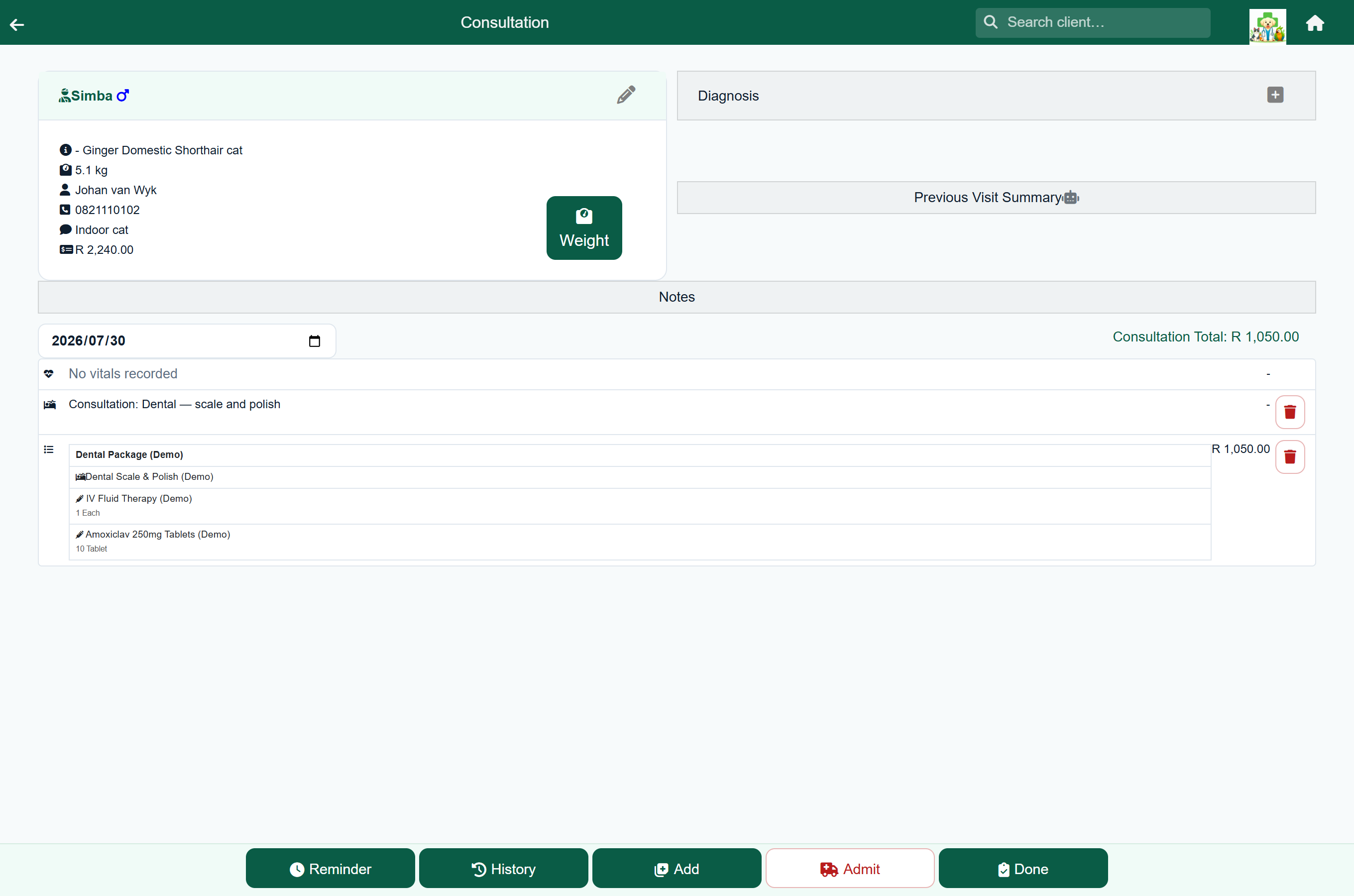
In that example the dental package is R1,050. Beneath it are a scale and polish, a bag of fluids and ten antibiotic tablets — R1,195 at their own prices — and the Consultation Total is R1,050.
Building a protocol#
Home›Stock & Prices›Update Prices
- Add a new price item, or open an existing one.
- Under Type of Price, choose Protocol. A Protocol Details section appears.
- Give it a description the vet will search for, such as “Dental Package”.
- Set the price. This is the default Protocol Charge.
- If you want to use price groups on it, also fill in Cost and Markup %.
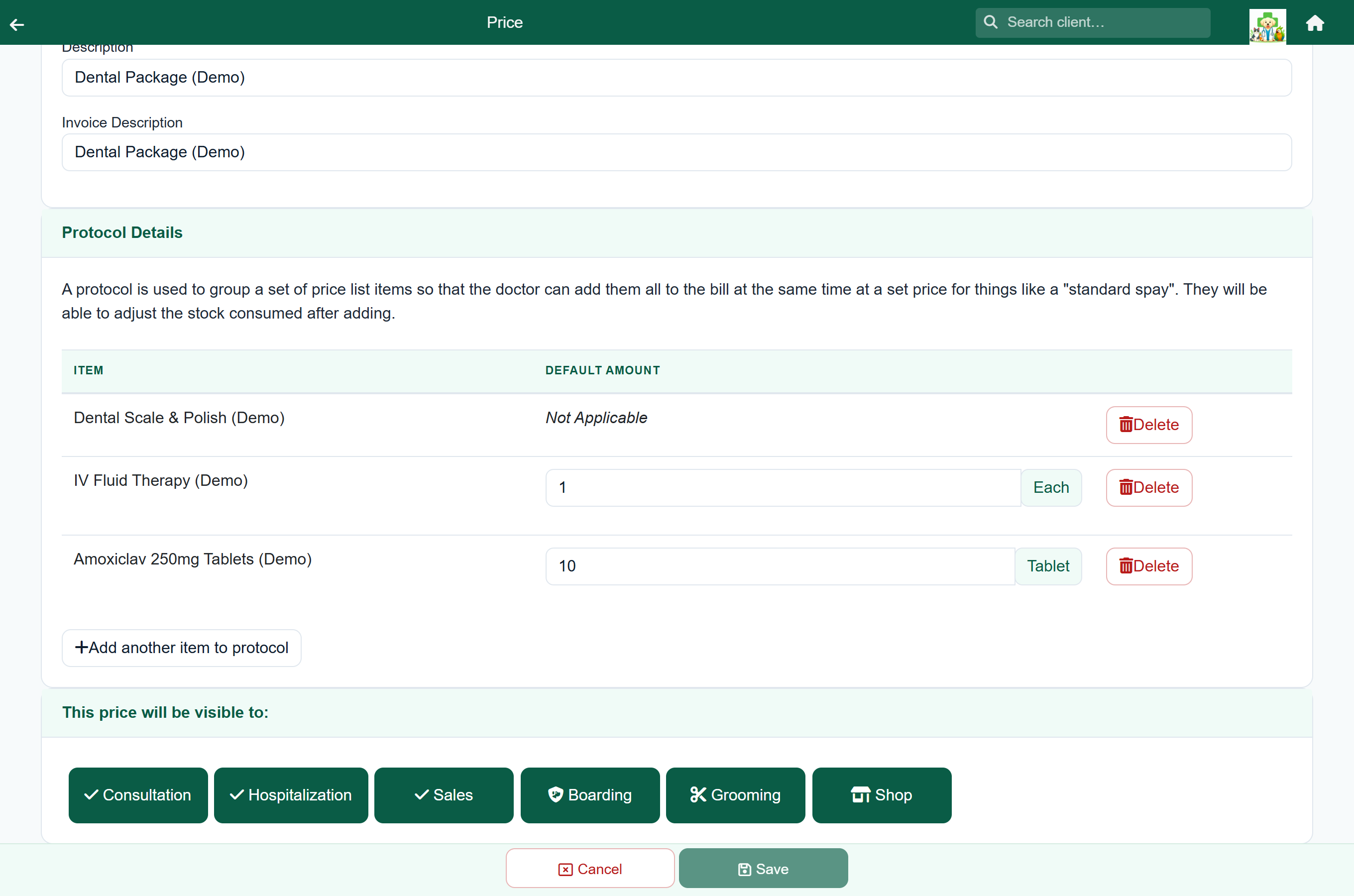
- Press Add first price to protocol and pick an item. Add the rest one at a time with Add another item to protocol.
- Give each one a Default Amount — the quantity this job normally uses.
- Choose where it can be charged under This price will be visible to, and press Save.
Why some items have no quantity#
In Protocol Details some rows have a Default Amount box and some read Not Applicable. That follows the item's type:
| Item type | Quantity? | Inside a protocol |
|---|---|---|
| Materials, Treatment | Yes | The quantity can be changed for each patient, including to zero. |
| Procedure, Lab | No — Not Applicable | Always included when the protocol is charged. |
Charging a protocol#
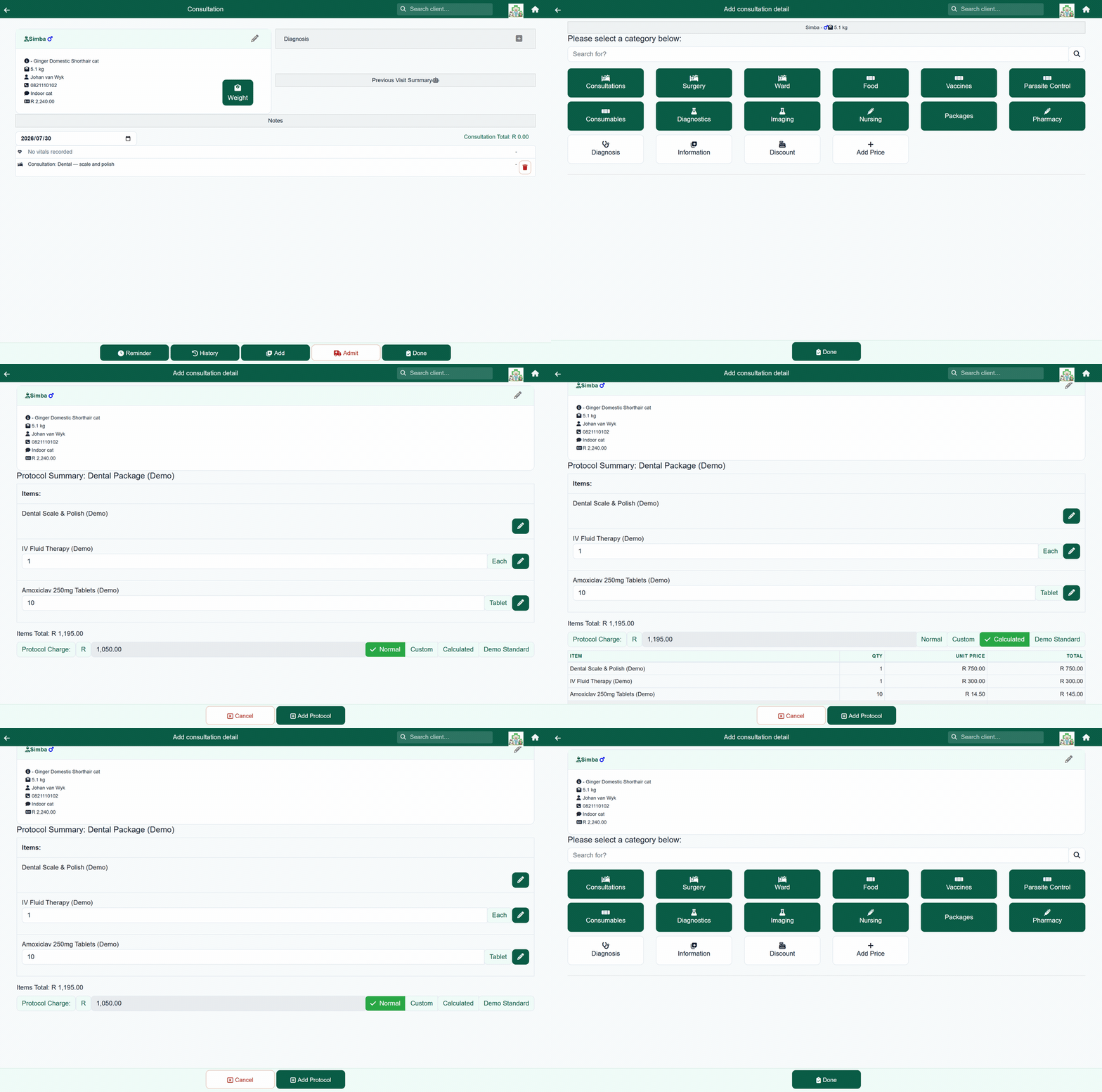
- On the consultation press Add and search for the protocol.
- A Protocol Summary panel opens.
- Change the quantities to what you used. Set anything you did not use to 0.
- Check the Protocol Charge, and change the mode if you need to.
- Press Add Protocol.
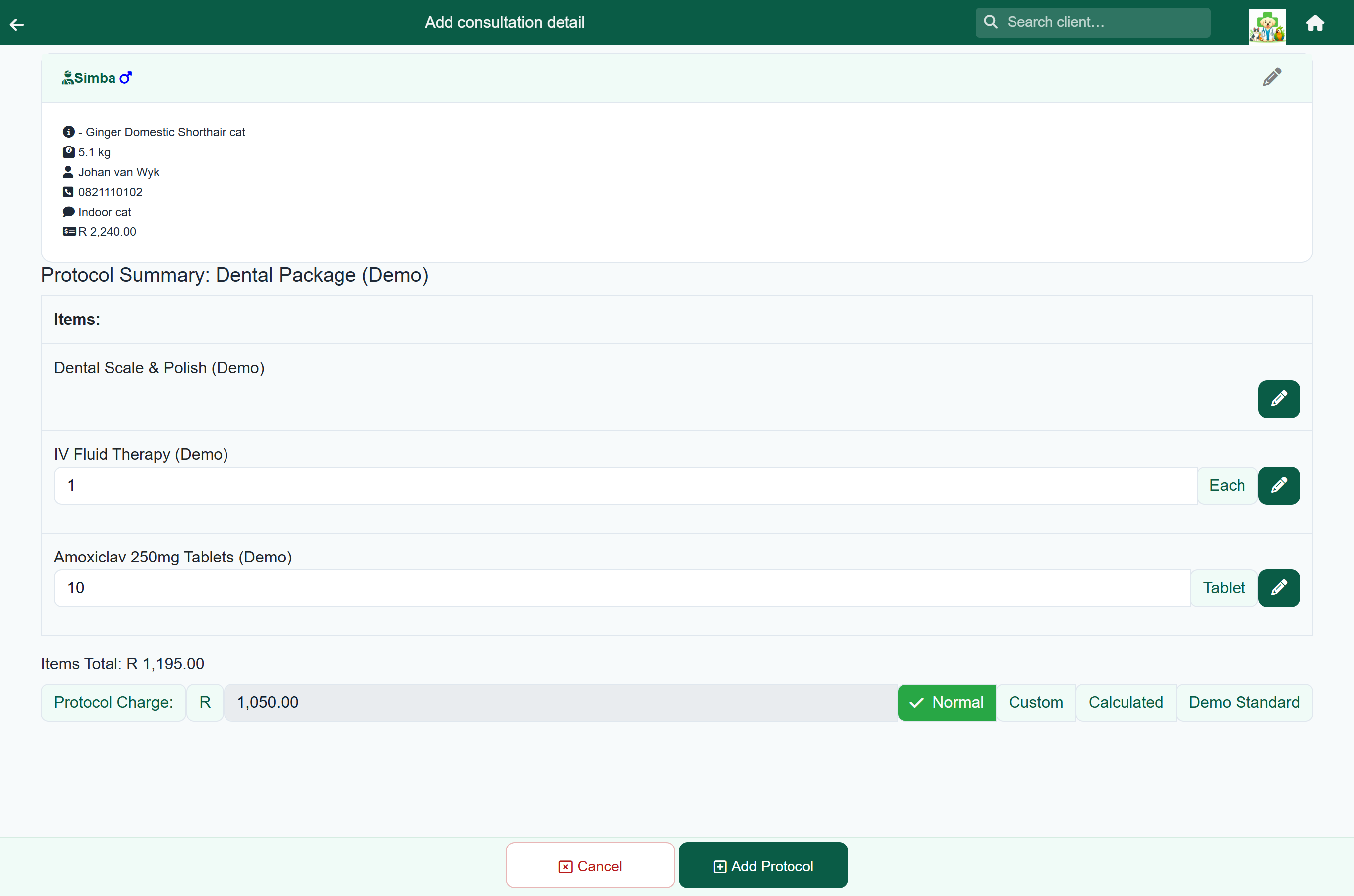
The pencil beside an item opens the full item editor for it — for example to set a dosage instruction and medicine label on take-home medication.
Cards or Grid. The two buttons at the top of the panel change how the items are laid out. Cards, the default, gives each item its own box. Grid puts every item on one row of a table, with the quantity and the unit price typed straight into the cells. Press Enter or the down arrow to go to the same cell on the next row, and Shift+Enter or the up arrow to go back up. The pencil at the end of a row opens the full item editor under that row.
Your browser remembers your choice. Every protocol you open on that computer or phone uses the same layout until you change it again. Other computers and phones keep their own choice.
If you type a new unit price in the grid, that item changes to a Custom price, as it does in the full item editor. Item prices change the bill only when the Protocol Charge is Calculated.
The four charge modes#
The buttons beside the Protocol Charge decide what goes in that one line. Above them, Items Total shows the items at their own prices, for reference.
The example below is a dental package: a package price of R1,050, items totalling R1,195, a cost of R500 and a price group at 100% markup.
| Mode | What it charges | Here | Follows the quantities? |
|---|---|---|---|
| Normal | The protocol's own price from the catalogue. This is the default. | R1,050 | No |
| Calculated | The sum of the items at their own prices × the quantities on screen. | R1,195 | Yes, as you type |
| Custom | Whatever you type. | — | No |
| A price group | The protocol's cost × (1 + that group's markup), plus VAT. It ignores both the package price and the items. | R1,150 R500 × 2 = R1,000, plus VAT | No |
Change the tablets from 10 to 20 and the Calculated charge goes from R1,195 to R1,340; the Normal charge stays at R1,050.
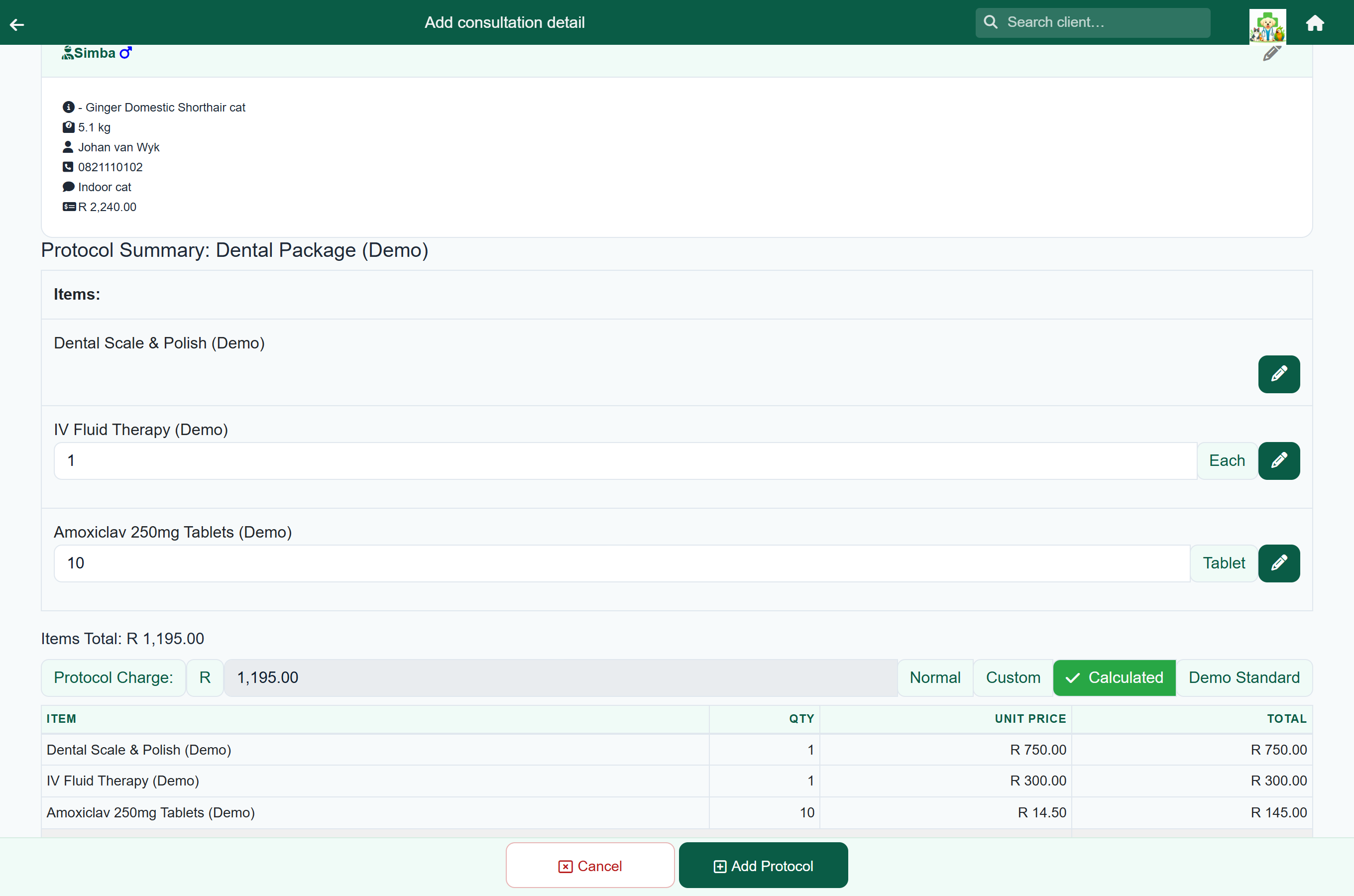
Calculated shows its working — item, quantity, unit price, line total and the calculated total — which is useful when a client asks what they are paying for. The bill still carries one line.
Protocols and price groups#
A price group on a protocol prices it from the protocol's cost: cost × (1 + the group's markup) + VAT. It does not discount the package price, and it does not look at the items.
Each item also has its own price-group buttons, through the pencil. They price that item from its own cost, so they change the Calculated total but make no difference in Normal mode.
| You want | Do this |
|---|---|
| A discounted package for a staff member or a rescue | Custom, and type the figure. Or give the protocol a cost and markup so the group gives the price you intend. |
| To bill exactly what was used, at group rates | Calculated, with the group set on each item. |
| Your normal package price | Normal. |
Changing or removing one afterwards#
| To | Do this |
|---|---|
| Change a quantity after adding | Open the protocol line on the consultation and edit the item. |
| Drop one item from the bundle | Delete that item's line. The protocol and its charge stay as they are. |
| Remove the whole thing | Delete the protocol line. This also deletes every item it added. |
Turning an existing item into a protocol#
If an existing price item is always charged with the same other items, you can turn it into a protocol.
- Open the item under Update Prices.
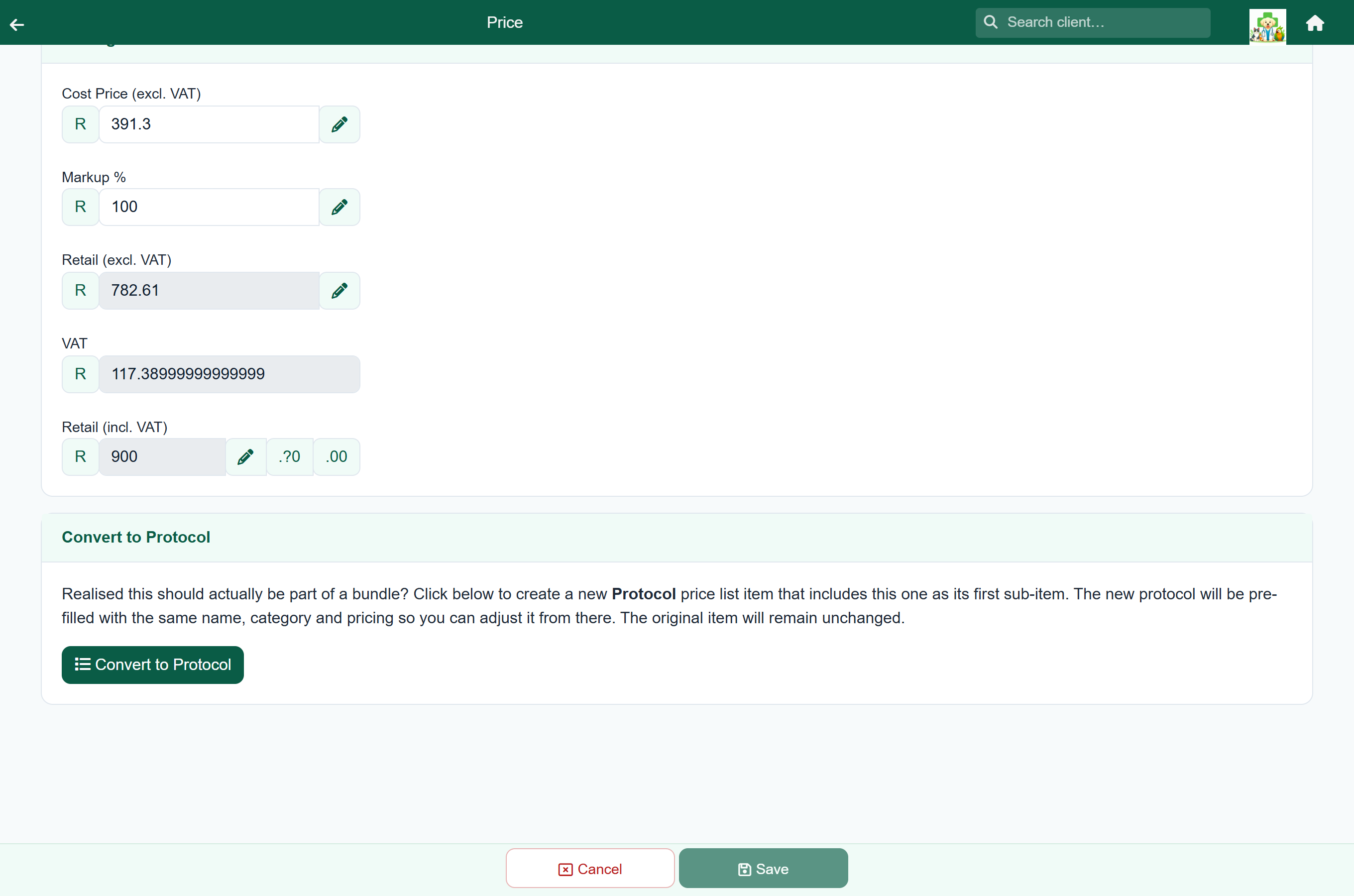
- Scroll to Convert to Protocol and press it, then confirm.
- A new protocol opens, with the same category, price and visibility, named with “(Protocol)” on the end, and the original item as its first item.
- Add the other items, adjust the name and price, and press Save.
What makes a protocol worth having#
- It matches a job people actually do. “Standard spay”, “dental”, “puppy first visit” — not “surgery”.
- The items are always used, or are Materials/Treatment items that can be zeroed.
- The name is what a vet would search for.
- The price is reviewed. Compare Items Total with the package price a couple of times a year.
- There are only a few. Six protocols people use beat thirty nobody can find.