
Help Centre › Money
Accounts & payments
Take payments, read a client's account, issue statements, and correct charges that were wrong.
Every client has one running account. Consultations, hospital stays, boarding, grooming and sales all post charges to it; payments and credits reduce it. The balance is the sum of everything on it.
Taking a payment#
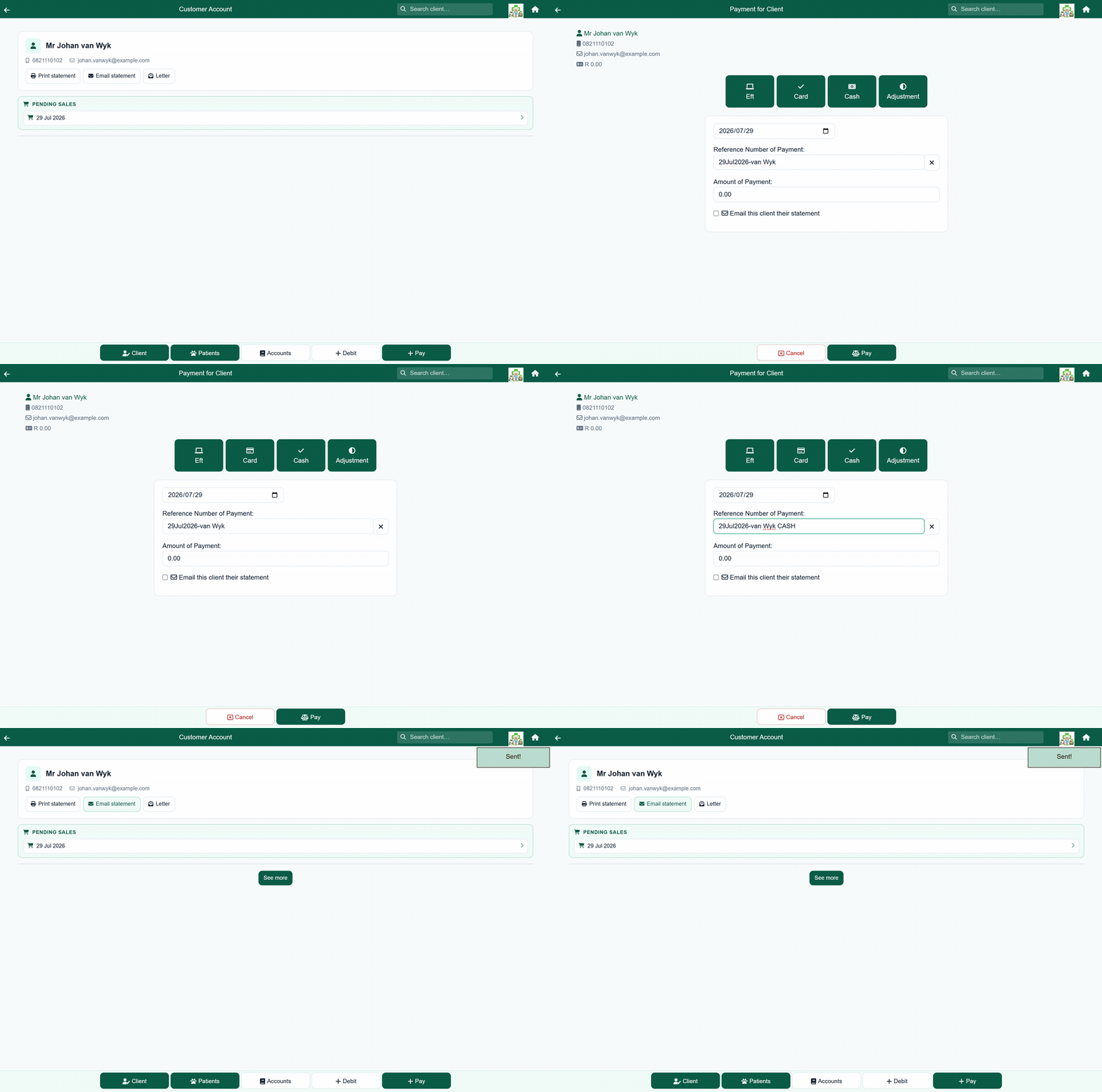
- Open the client's account — tap them on the payment queue, or search for them and press Statement on their record.
- Press Pay in the footer.
- Choose how they paid: Eft, Card, Cash or Adjustment.
- Check the date. It defaults to today.
- Check the reference number and the amount. Both are filled in for you — the amount with the full balance — and both are required.
- Press Pay.
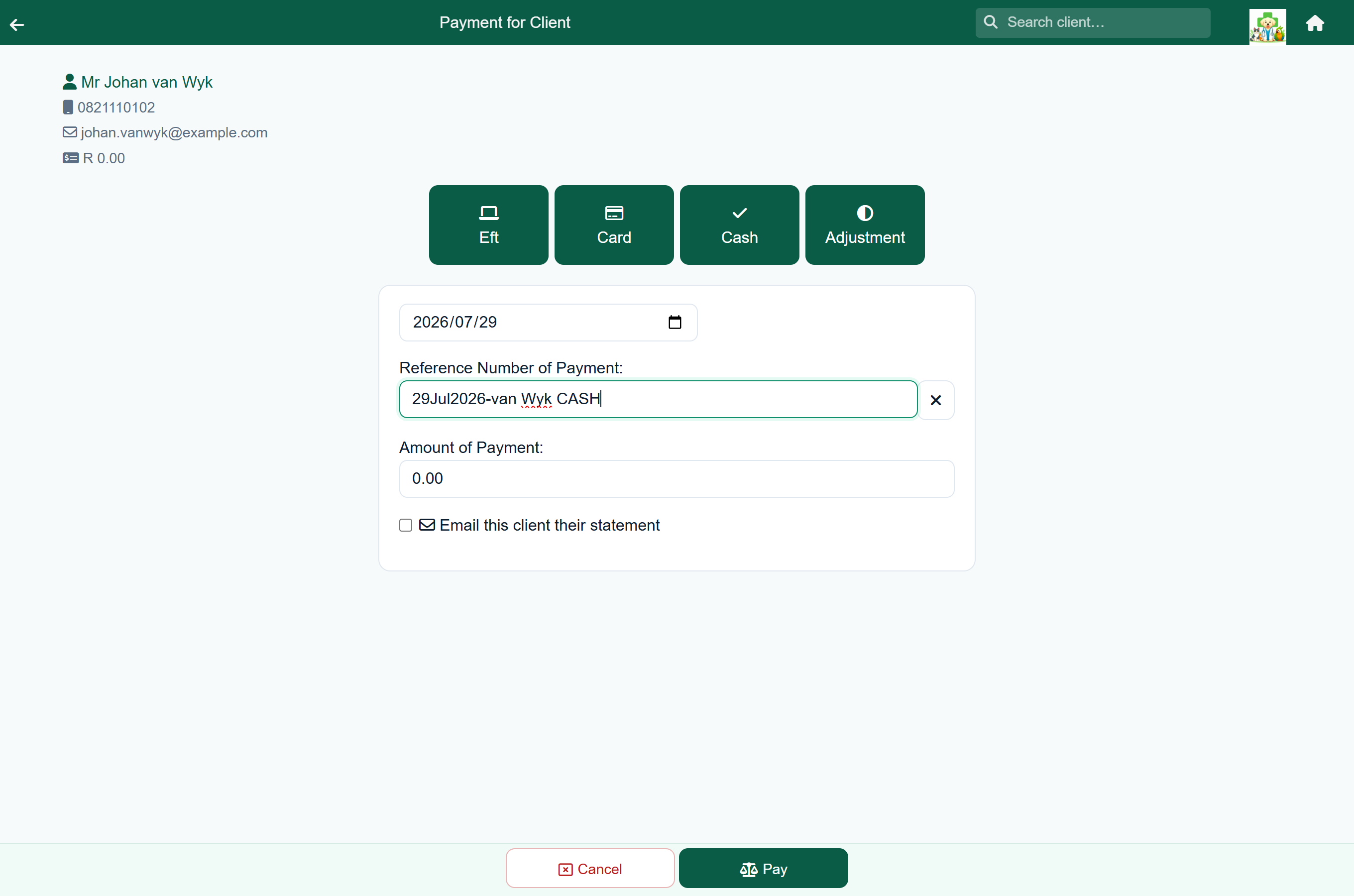
The payment appears on the account straight away and the balance drops. Tapping a client on the payment queue takes them off it.
Reading a client's account#
Home›Search Client›the client›Statement
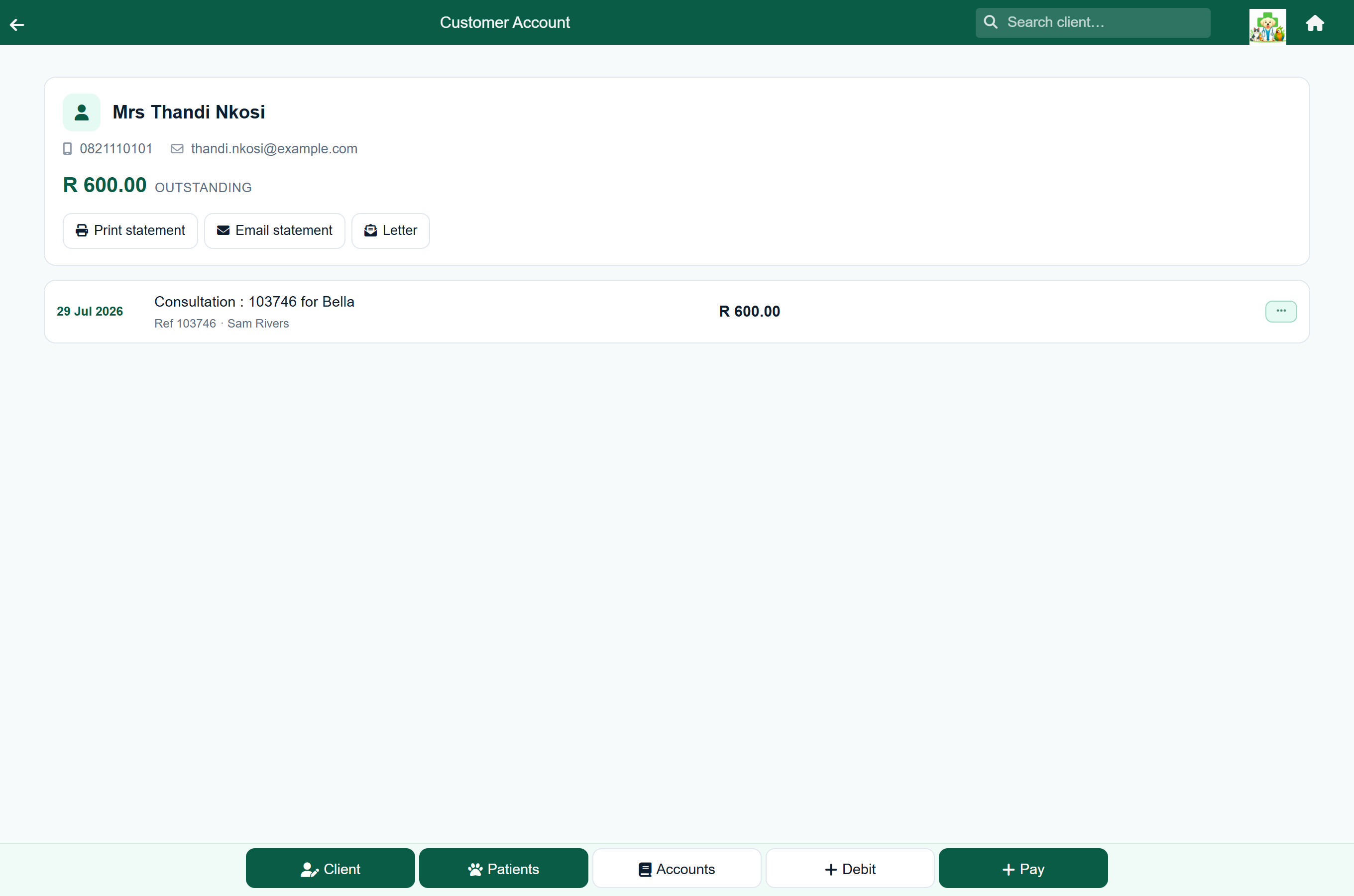
The Statement button on the client record opens the account. It lists every entry with its date, description, reference and amount. Positive amounts are charges; negative amounts are payments and credits. A settled account shows Paid up.
| Type | Means |
|---|---|
| Consultation | A finished consultation or dispense. |
| Sale | A counter or shop sale. |
| Hospital / Boarding | A discharged stay. |
| Grooming | A finished groom. |
| Receipt | Money received from the client. |
| Manual debit | A charge added by hand. |
| Interest | A monthly finance charge on an overdue balance — see Interest on overdue accounts. |
| Reversal credit | The credit written when a charge is reversed. |
Tap the … button on an entry to show its actions: view the record, print or email the invoice or the itemised detail, share it, or reverse it.
To send a statement, use the print and email buttons at the top of the account. A long account loads in pages; See more at the bottom fetches the next batch.
The 30, 60 and 90 day badges#
Next to an outstanding balance you may see a coloured badge. It shows how old the debt is, not how much it is.
| Badge | Means |
|---|---|
| none | The balance is current, or under 30 days old. |
| 30 days (grey) | Money has been outstanding for around a month. |
| 60 days (amber) | Around two months. Worth mentioning while the client is in front of you. |
| 90+ days (red) | Around three months or more. |
The badge appears on the client record, the account, the Pay and Debit screens, the Send Invoice screen, and the patient panel on a consultation — so the vet sees it before starting work.
Adding a charge by hand#
Debit adds a charge that did not come from a visit or a sale — a missed-appointment fee, a cremation charge passed on, an agreed contribution.
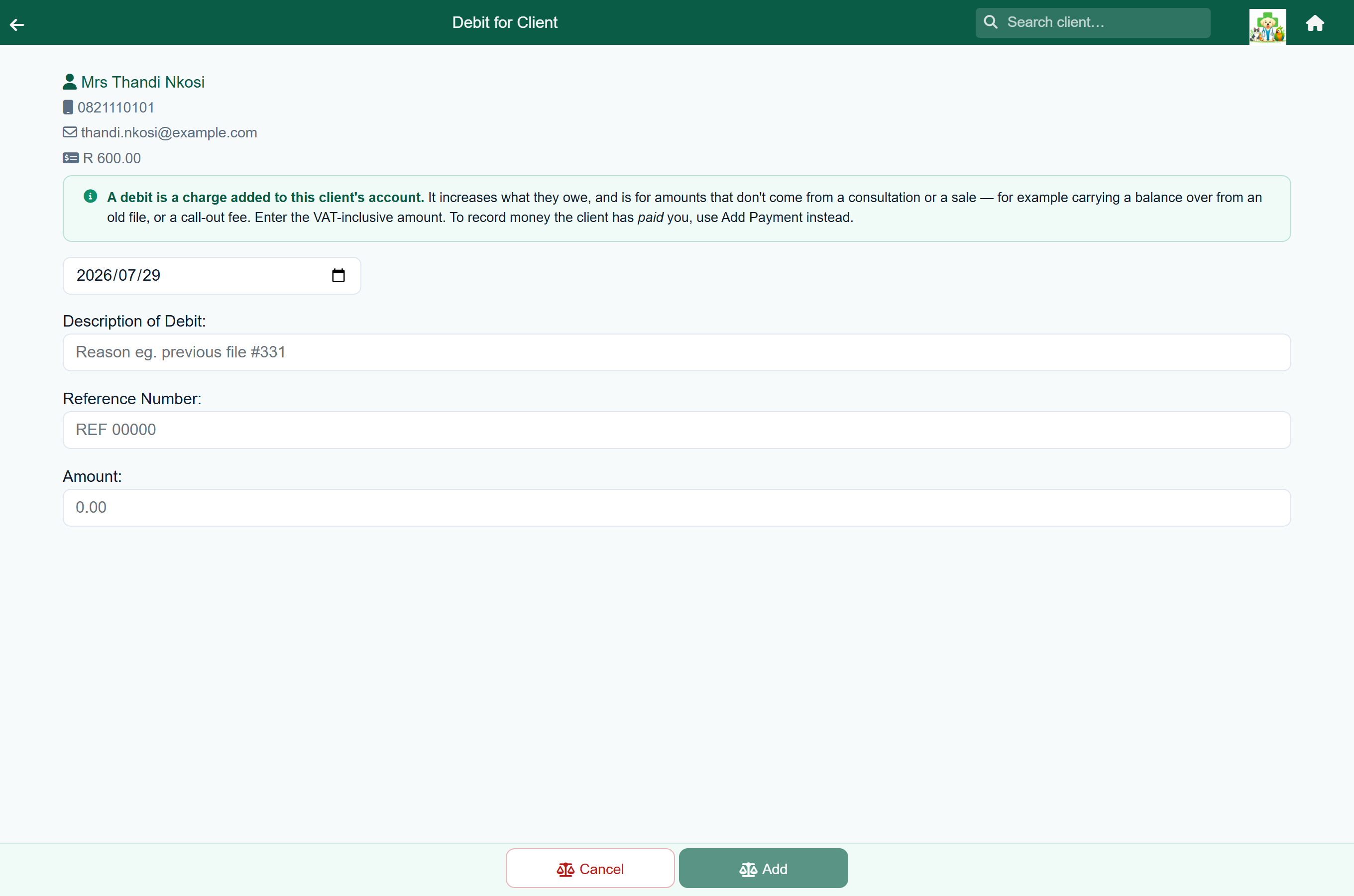
- Open the client's account and press Debit in the footer.
- Check the date, then enter a clear description (the client will see it), a reference number and the amount.
- Press Add.
Reversing a charge#
Charges are never deleted. Reversing marks the original entry Transaction reversed and writes a matching credit, so the account shows both the charge and the correction.
- Open the client's account and find the charge.
- Press the … button on it.
- Press Reverse — or Readmit on a hospital or boarding charge.
Reversing a consultation, dispense, sale or groom puts the stock it used back on the shelf. Readmit reopens the hospital or boarding stay so you can correct it and discharge it again.
Payment terms, credit limits and holds#
Set your practice’s payment terms under Settings → Billing & Payments. To give one client different terms, edit their record and use the Account section.
| Setting | What it does |
|---|---|
| Payment Terms | How many days a client has to pay. It prints on the statement, and overdue emails wait for it. What the days count from depends on how your practice bills. Blank on a client means “use the practice’s terms”; blank on the practice means 30 days. |
| Credit Limit | What you are willing to carry for this client. Once the balance passes it, the client record shows Over credit limit. It does not block anything. |
| Account on hold | Shows Account on hold on the client’s record, so staff know you have stopped working on account for them. It does not block anything. |
| Default Rate | A price group this client is always charged at — rescue, breeder, trade. New lines use it automatically, and staff can still change any line. Only shown if your practice has price groups. |
| Account Code | The debtor code your accountant uses for this client. It is included in the accounting export. |
Statements#
A statement ends with the payment terms, the date the oldest unpaid charge falls due, and an ageing line (current, 30, 60, 90+ and total due). Under it is the payment reference to pay with, and the client’s account code if they have one. Where a piece of work carries the client’s order number, it prints beside that line under Your ref.
To send one, open the client's account and use the print or email button at the top. The email button only appears if the client has an email address on file. Your practice can also send statements automatically, and with every payment — see Email & notifications.
How your practice bills. Choose one of two models in the Statements card under Settings → Billing & Payments. It decides when money falls due and when a client is chased.
| How you bill | What it means |
|---|---|
| Each invoice on its own terms | The default. Each charge is due your payment terms after the day it was raised. No routine statement goes out — a client hears from you when they are late. |
| One statement a month | One statement goes out on the day you choose — the 1st to the 28th, or the last day of the month. Everything on it falls due your payment terms after the statement date, so every account client is due on the same day. |
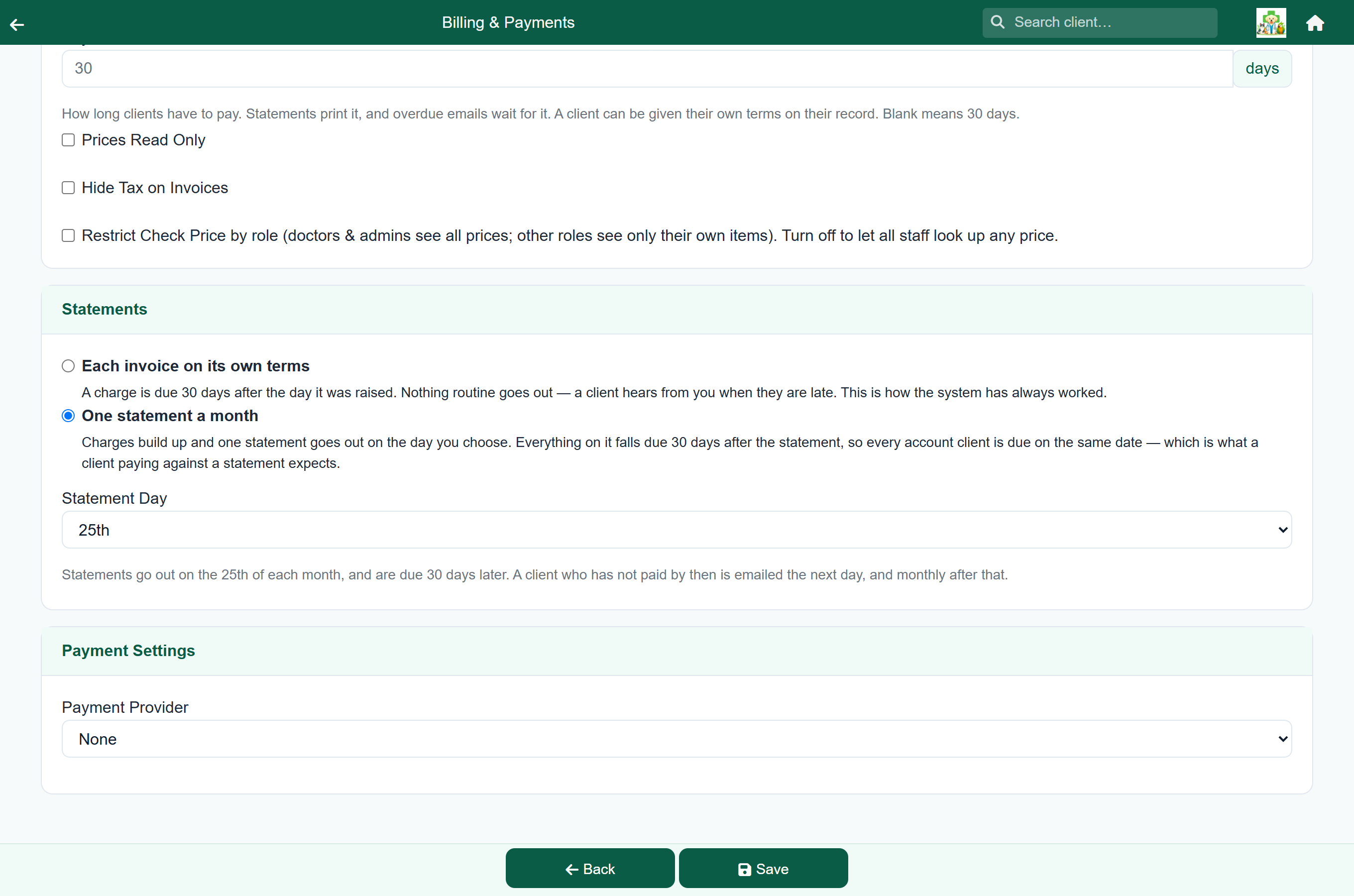
Payment terms still belong to the client under either model: a client on 60 days gets 60 days from the statement.
Under either model, a client who has not paid by the due date is emailed the next day and monthly after that, as long as Email overdue account statements is on under Settings → Email & notifications. If a statement day and a chase day fall together, the client gets only the overdue email.
Invoices#
Finishing a consultation, sale or groom, or discharging a stay, raises an invoice. If automatic invoice emails are on, the client is emailed it straight away. You can also send it by WhatsApp or text, or send it again from the account at any time.
To leave tax off your invoices, tick Hide Tax on Invoices under Settings → Billing & Payments.