
Help Centre › Appointments & queues
Appointments & bookings
Work the appointment book: make, move and cancel bookings, and turn an arriving appointment into a waiting patient.
The appointment book is a grid of time slots. An administrator sets up the slots once, and reception fills them.
The day's bookings#
Home›Bookings
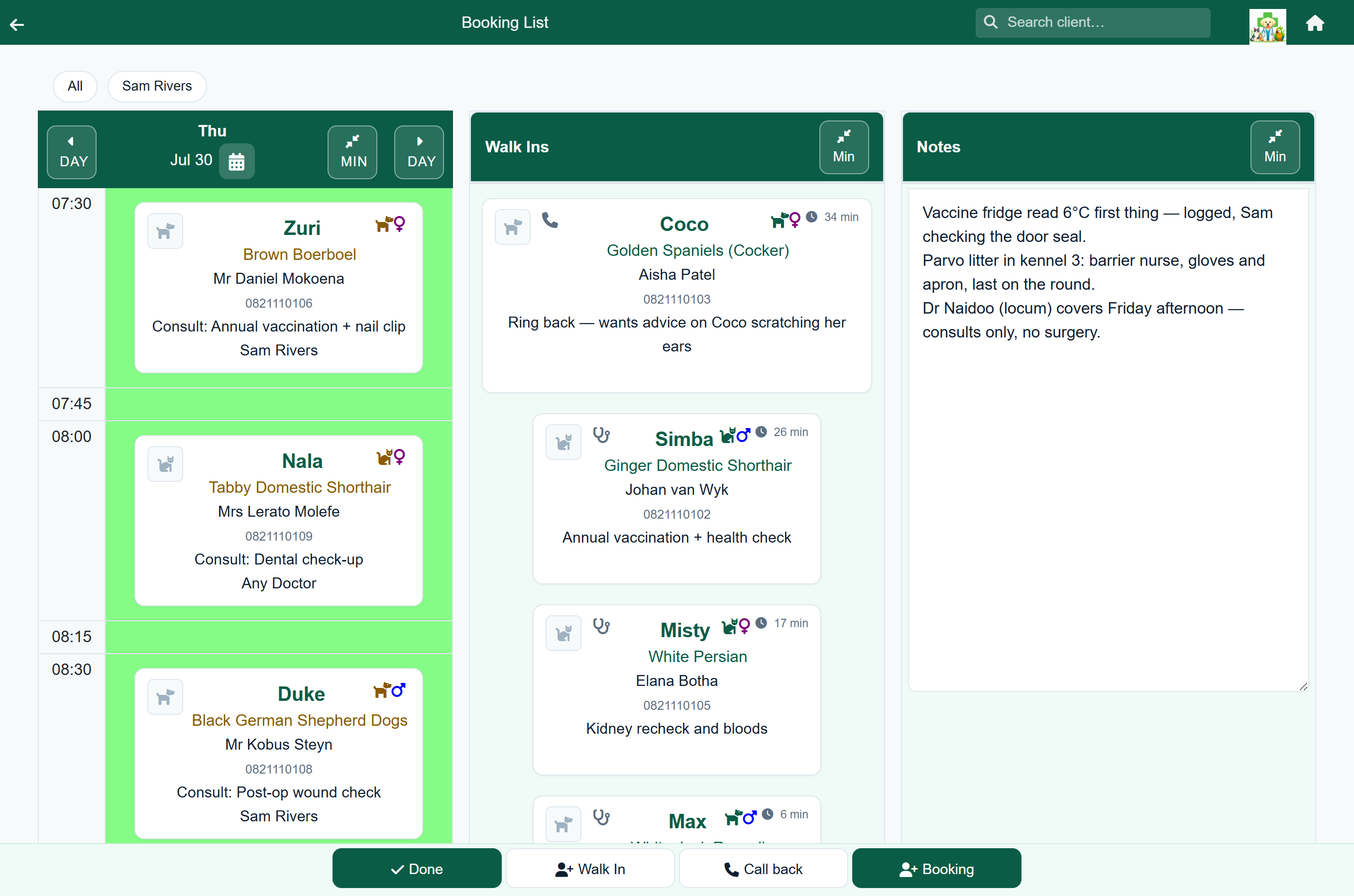
The booking list shows one day: who is coming, when, with which animal, why, and with which vet. Use the Day arrows to move between days, tap the date to jump to another, or press Week to see the whole week. The vet buttons along the top filter the list to one vet.
- Tap a booking to show its actions: Weigh In when the patient arrives, Postpone, Cancel, Client, and later Open Consult or Pay.
- Bookings clients make through the client portal appear here with the others.
- Walk Ins lists every patient waiting on a queue without an appointment, longest wait first, and shows only when you are looking at today. Each card shows how long the patient has waited; entries from an earlier day are highlighted.
- Notes is a shared notepad for the day. Everyone sees it, and it saves as you type.
- Each panel has a Min button to shrink it and give the others more room.
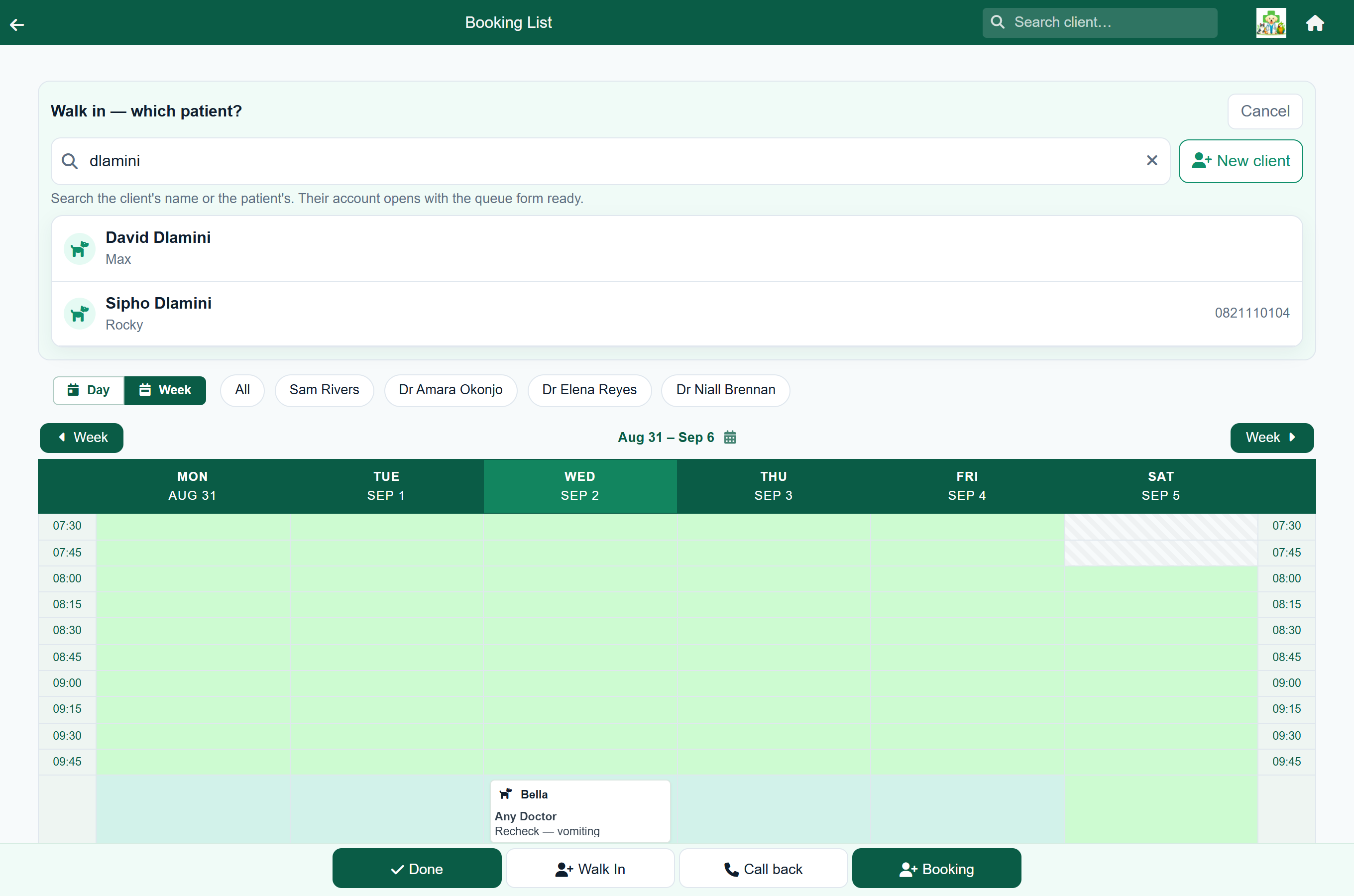
Walk In and Call back in the footer first ask which patient. Search by the client's name, phone number or the patient's name and tap them; their account opens with the queue form ready.
The whole week at once#
Home›Bookings›Week
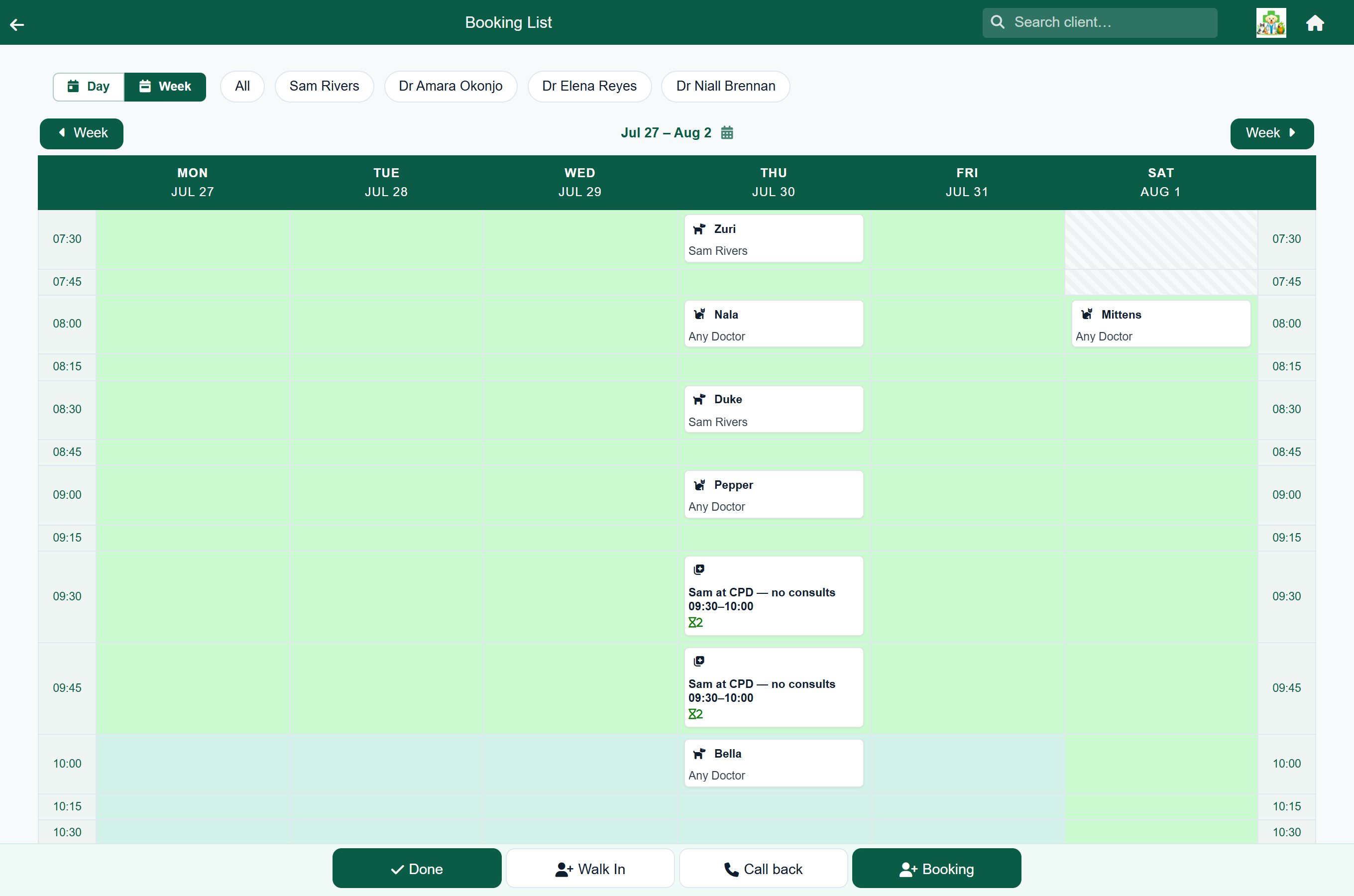
Week shows the appointment book with a column per day, so you can see where there is space. Days your practice is closed are left out.
- Each row is a clock time, so 09:00 lines up across every day. Where a day has no slot at that time, the cell is shaded.
- A card shows the patient and the vet. When you filter to one vet, it shows the reason instead.
- A booking that takes several slots shows an hourglass with the number of slots, and fills all of them.
- A note shows its text, for example a staff meeting. A note does not take up the slot unless it names a vet: “Dr Naidoo at the dentist” holds that vet for the time, and the slot stays open for other vets. For planned leave, use Vet Availability instead.
- Tap a booking, or a day's heading, to open that day. Actions on a booking are on the day view.
- Tap an empty part of a slot to start a booking in it.
- Use the Week buttons either side of the date range to move a week, or tap the date range to jump.
Making a booking#
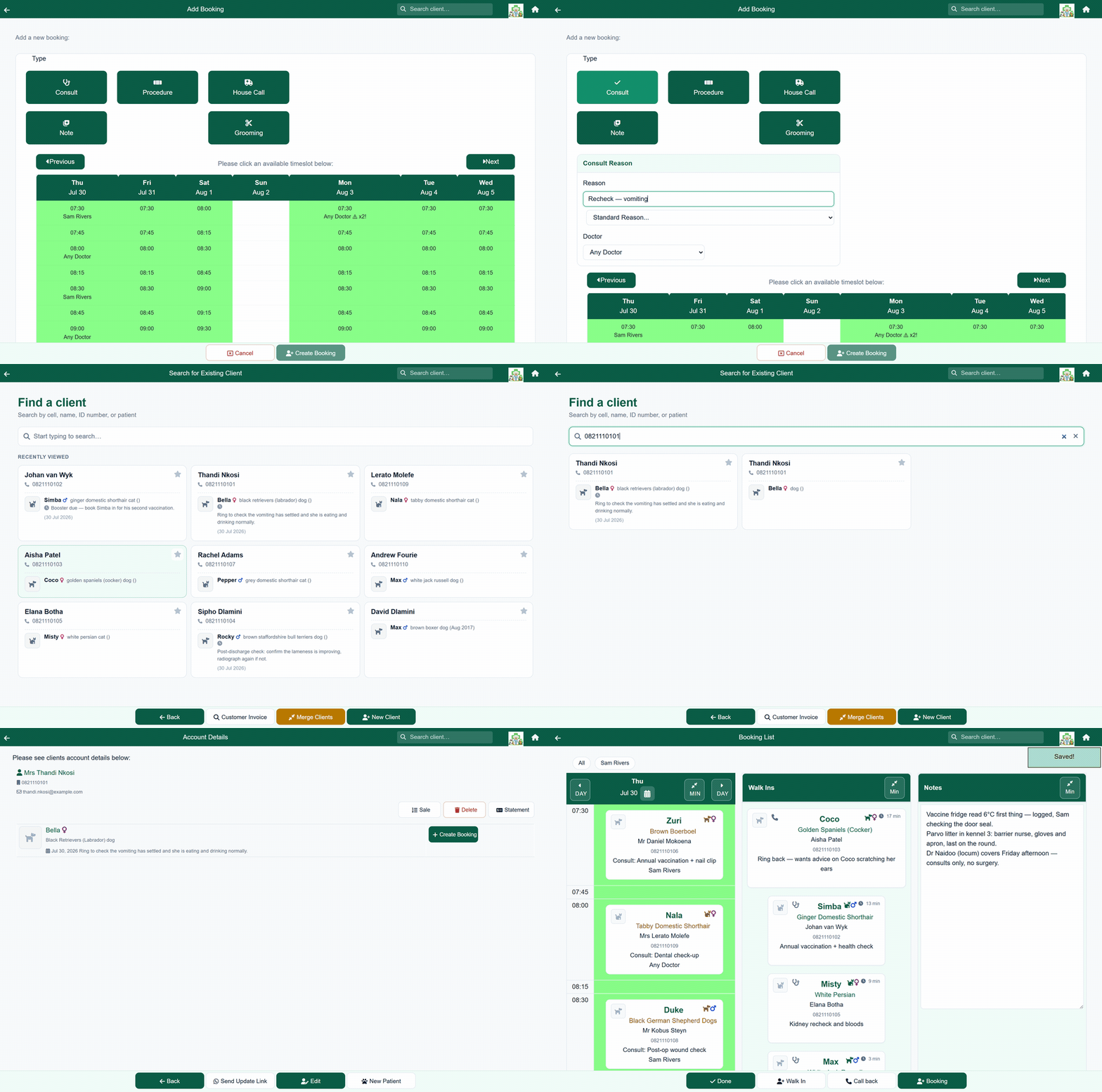
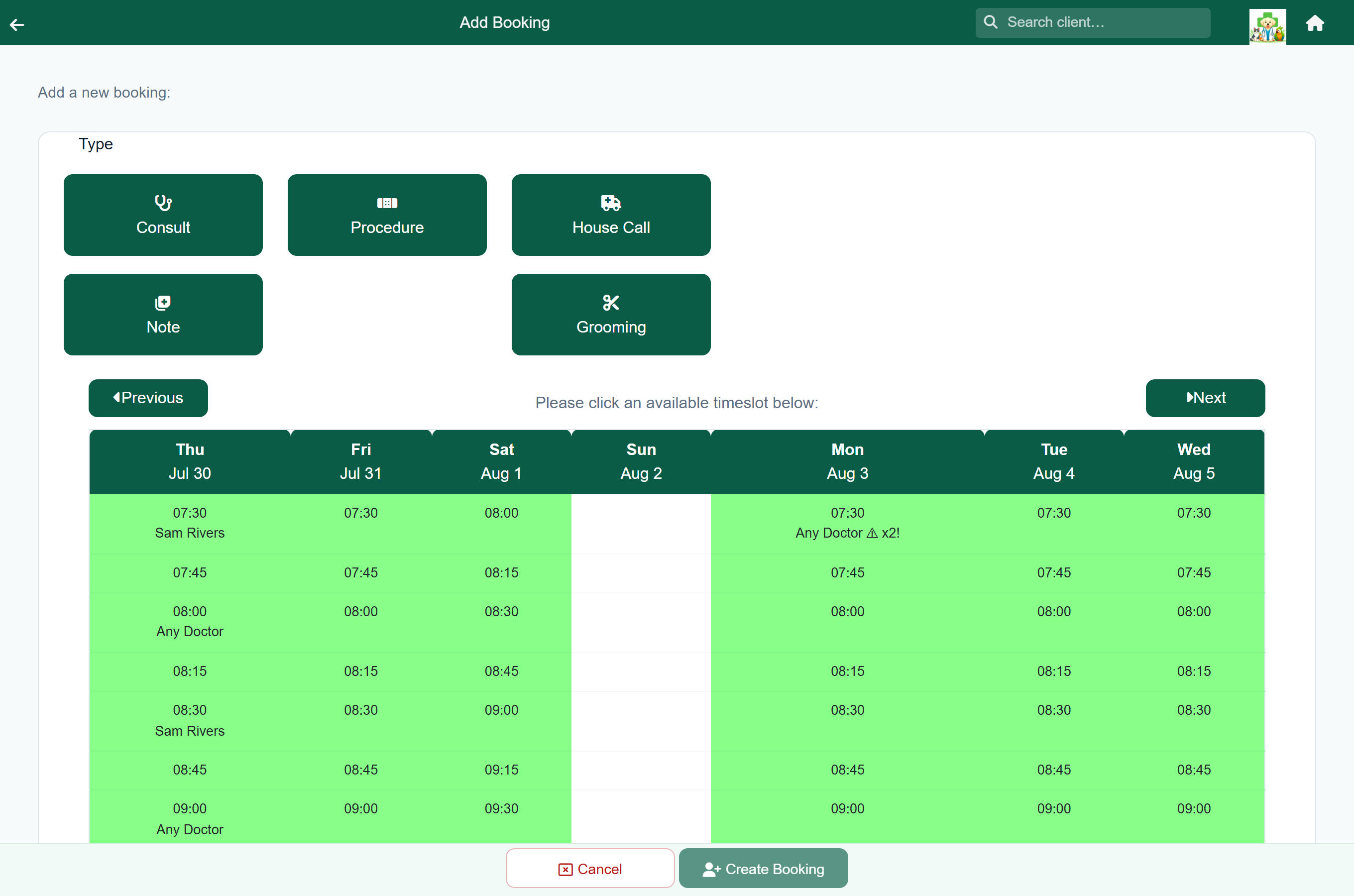
- From Home choose Bookings, then press Booking in the footer.
- Check the booking type. Consult is selected; change it to Procedure, House Call, Note or Grooming if needed. Consult, Procedure and House Call appear only if your practice uses consultations, and Grooming only if it uses grooming.
- Under Patient, search for the client or the patient and tap them. If the client has more than one patient, you are asked which. For a new client, New client opens the short signup form and makes the booking when you save. A Note has no patient; instead, Who is this about? lets you name a vet to hold for that time, or leave it on Nobody in particular.
- Type the reason, or choose one from Standard Reason..., and pick the vet or leave Any Doctor. A grooming booking asks for a grooming reason and notes, and offers Any Groomer.
- Use Previous and Next to find the week, then tap a free time slot.
- Press Create Booking.
A course of appointments#
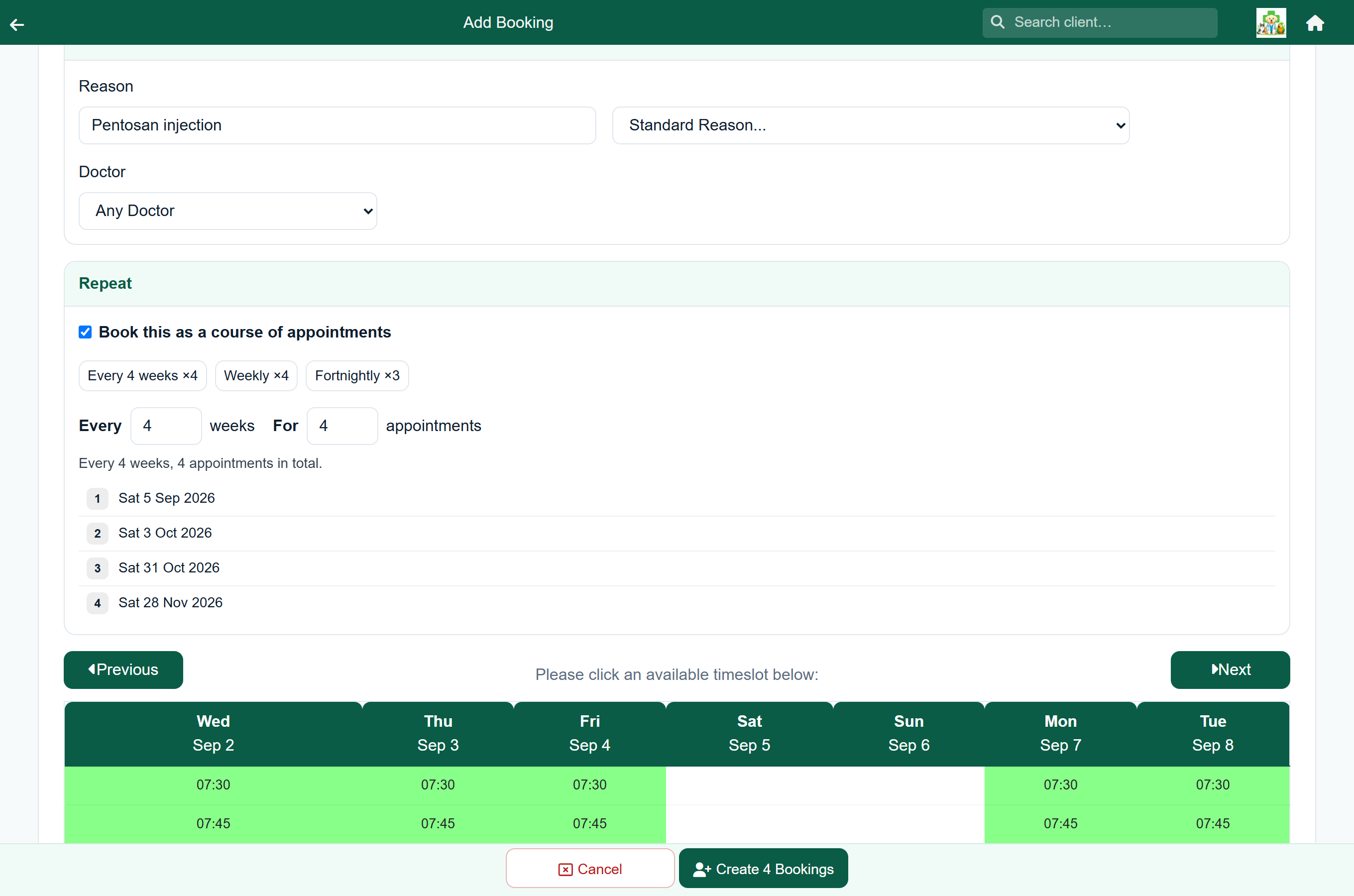
For a course of treatment, such as four injections four weeks apart or a puppy vaccination series, book all the appointments at once.
- Fill in the booking as usual: type, patient and reason.
- In the Repeat panel, tick Book this as a course of appointments.
- Choose a preset, such as Every 4 weeks ×4, or enter how many weeks apart (Every) and how many appointments (For).
- Tap the time slot for the first appointment. The dates of the whole course appear in the Repeat panel.
- Check the dates, then press the button, for example Create 4 Bookings.
Every appointment is on the same weekday and time as the first. A course can repeat every 1 to 12 weeks, for 2 to 26 appointments.
Once made, each appointment can be moved, cancelled or opened on its own without affecting the others. To stop a course, tap the appointment to stop at and press Cancel Rest: it and all later appointments in the course are cancelled.
When the client arrives#
When a booked patient arrives, put them on the queue so the vet can see they are waiting.
- On the booking list, tap the booking and press Weigh In. This opens the arrival form.
- Fill in what you have, and press Save.
| Field | What it is for |
|---|---|
| Weight (kg) | The weight taken on arrival. Decimals are fine, for example 12.4. |
| Approximate Weight (kg) | An estimate, for an animal you could not weigh properly. |
| Doctor | The vet they are seeing, or Any Doctor. |
| Reason | Why they are in. It shows on the queue card and the consultation. Type it or pick from your practice's consultation reasons. |
The patient now appears on the consult queue with their reason.
Moving or cancelling#
Tap the booking on the booking list. Press Postpone to choose a new time, then Update Booking. Press Cancel to cancel it; the slot is freed straight away.
Defining your appointment slots#
An administrator sets up the grid of times under Appointment Slots.
Home›Settings›Appointment Slots
Describe the week as sessions, for example “Monday to Friday, first appointment 07:30, last 13:00, every 20 minutes, 2 patients at a time”. Pick the days with the day buttons. The count on the right shows how many times the session creates.
Underneath, How the week will look shows the result as the booking screen will: days across, times down, and the number of patients that can be booked at each time.
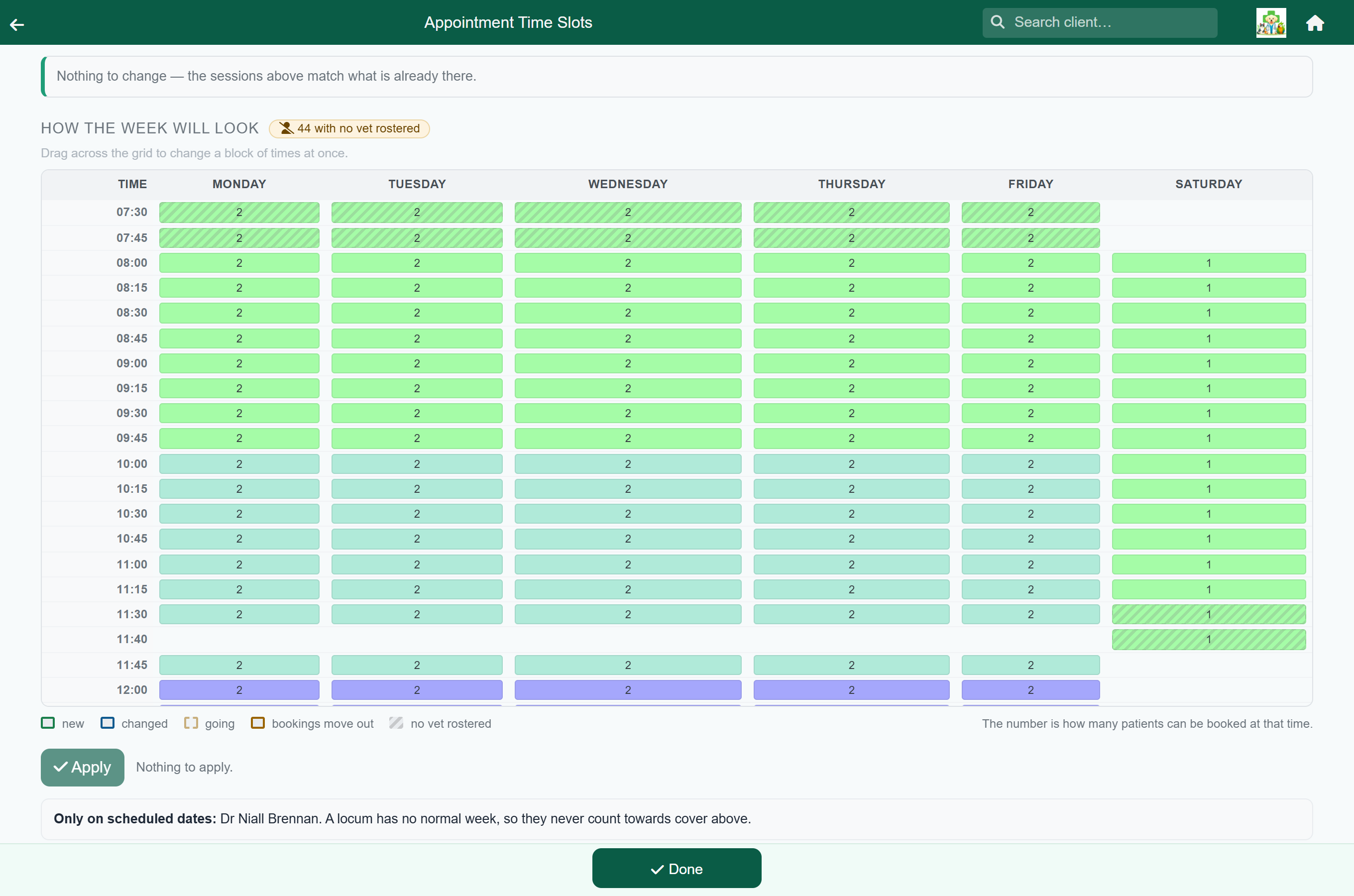
Drag across the week grid to change a block of times at once, such as setting the capacity or colour for Monday to Wednesday afternoons.
- Shift everything moves every session earlier or later by the minutes you choose. It adds the new times and keeps the old ones unless you also tick the remove box.
- Add the standard week adds a standard set of sessions to your list, without changing yours.
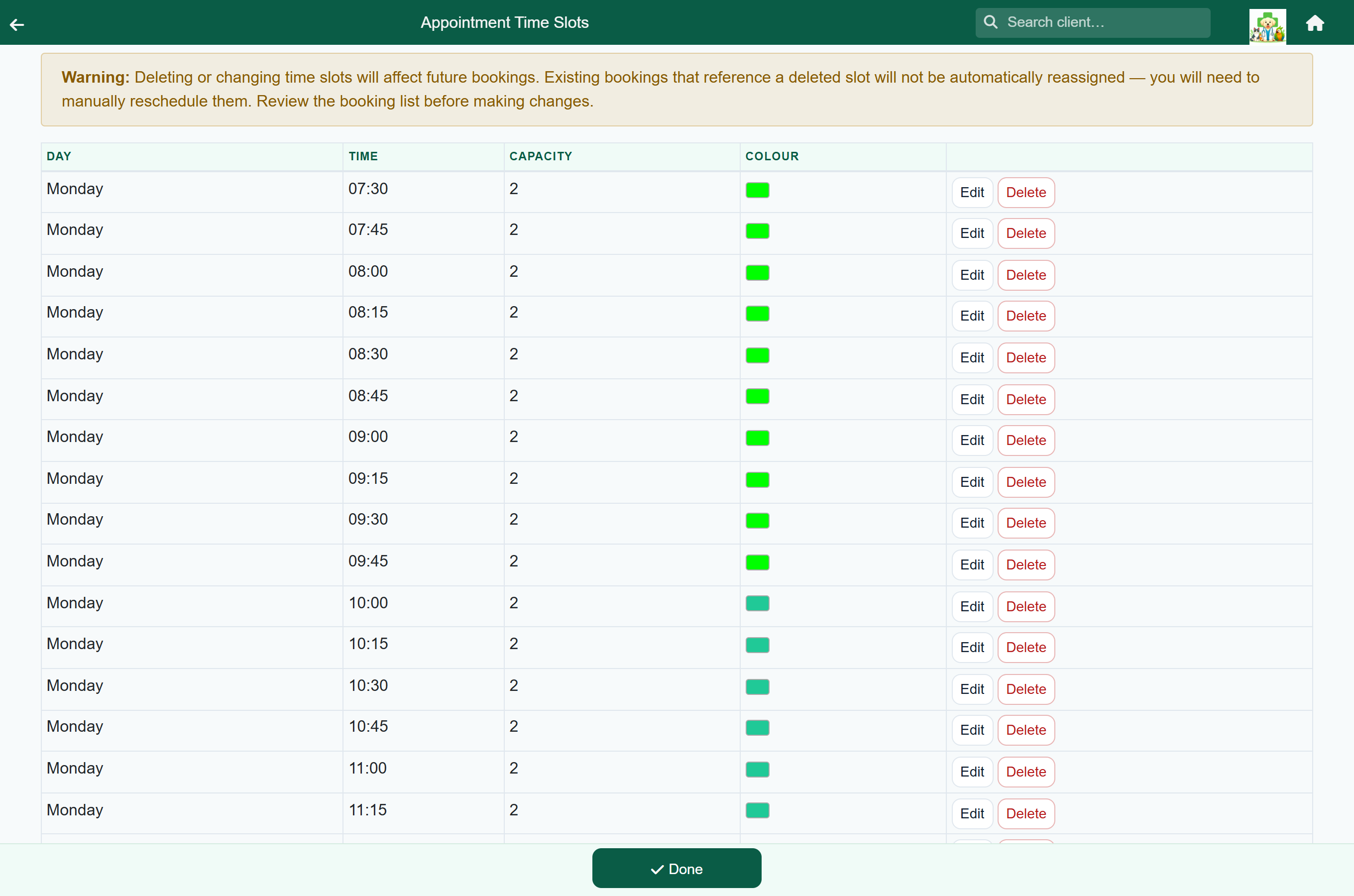
A time that fits no session, such as a single extra Saturday slot, is edited under Individual appointment times at the bottom. Removing one there moves its appointments the same way.
Each time has a day, a time, a capacity (how many patients can be booked at that time) and a colour. Different days can have different hours.
Capacity counts appointments, not vets: a capacity of 2 allows two bookings at that time, whoever they are with. To control which vet is in, use per-vet availability.
With per-vet availability on, the week grid marks any time with no vet rostered and counts them above the grid. A time also shows as full once every rostered vet is booked, even if its capacity is higher. So you can set capacity for a fully staffed day and let the roster lower it on days you are short.
Per-vet availability#
Appointment slots say when the practice is open. Vet Availability says which vet is working, so two appointments at nine o'clock are not both given to the same vet, and a vet who works mornings is not offered in the afternoon.
Home›Settings›Vet Availability
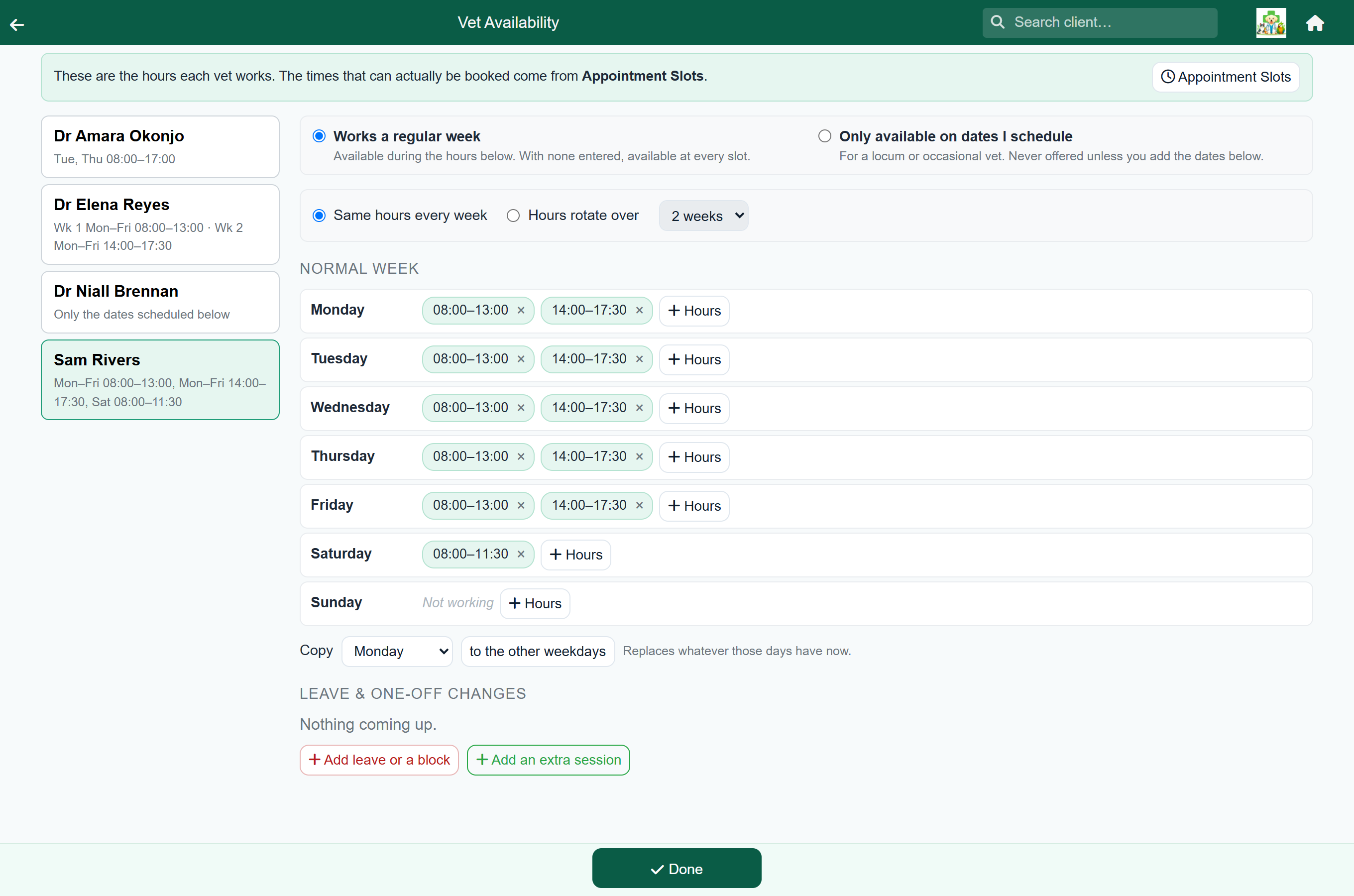
Pick a vet, then add the hours they normally work on each day. For a split day, add two sets of hours. Copy copies one day's hours to the other weekdays.
For rotations, alternate weeks and locums, see Advanced vet scheduling.
Leave & one-off changes sits underneath. Add a date or range for leave, a surgery list or a course, with a reason reception will see. You can also add an extra session on a day the vet does not normally work.
Booking outside a vet's hours#
You can always book a vet outside their hours. The booking saves, and FastVet shows a note explaining what is unusual about it.
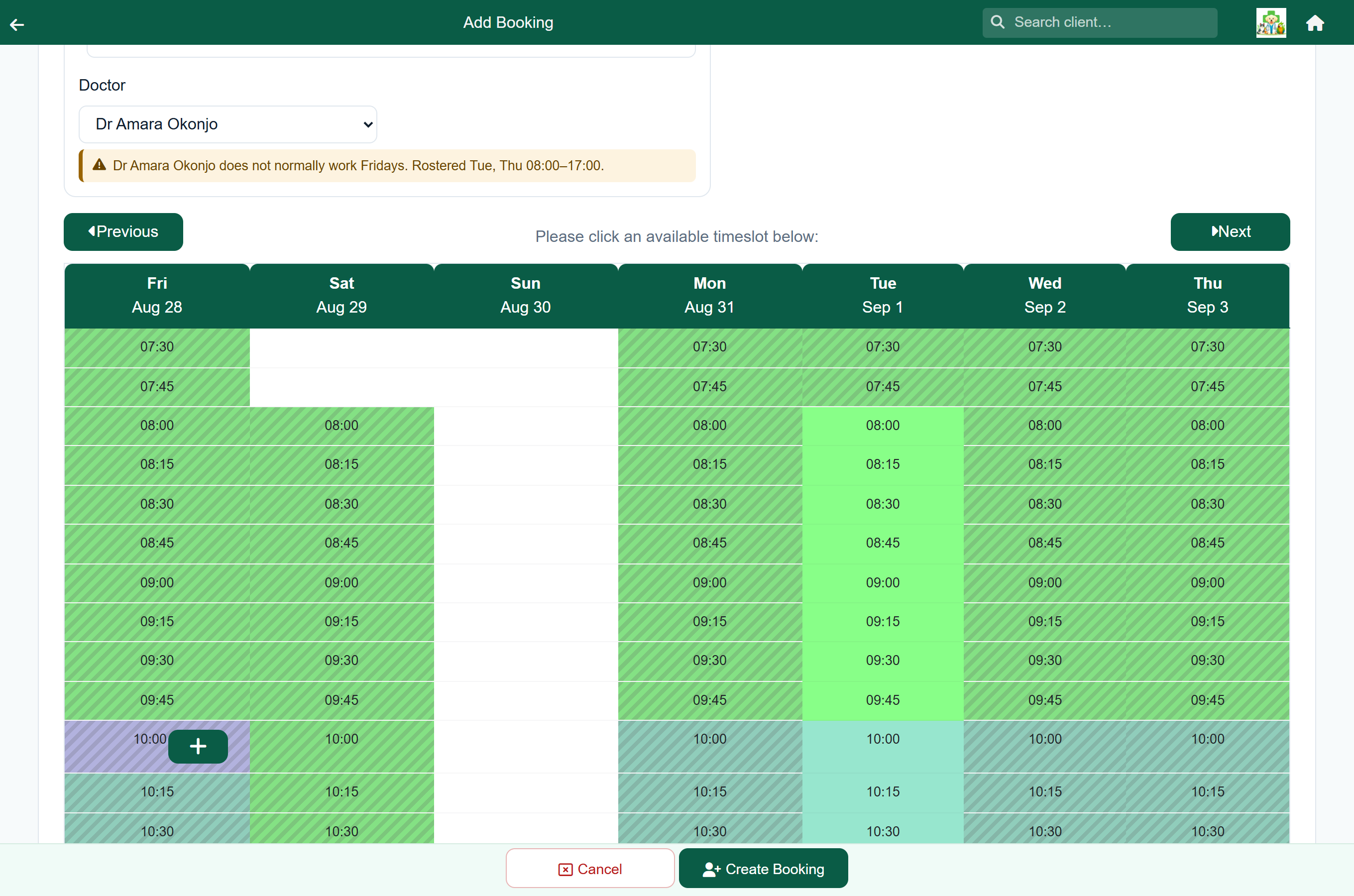
- Times outside the chosen vet's hours are shaded, and you can still book them.
- A note appears under the vet, for example "Dr Naidoo is rostered 08:00–13:00 on Wednesday — 14:30 is outside that."
- For a locum: "Tom Sawyer is only available on dates they are scheduled, and is not scheduled on Thursday."
- Making an appointment longer adds a note if it runs past the end of the vet's day.
- If the vet is already booked at that time, the note says so.
- Filtering the day view to one vet shades the times that vet is not working, with a line above the day showing their hours.
- On the booking list, an appointment outside its vet's hours is marked off roster, usually because the roster changed after it was booked.
- A time when every vet is already booked is shaded too. Any Doctor bookings, and diary notes that name a vet, count towards this.
The follow-up list#
Home›Follow Up
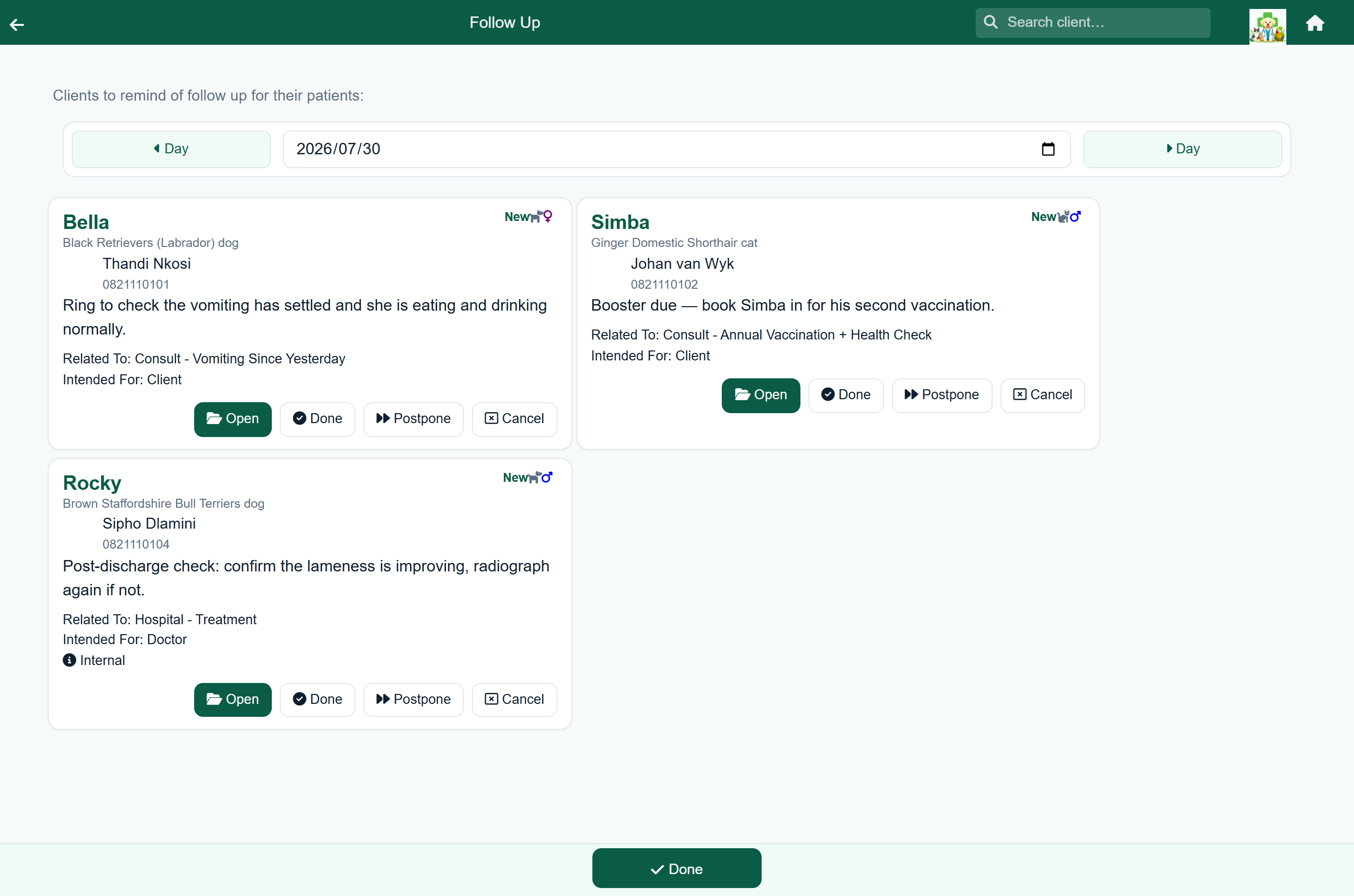
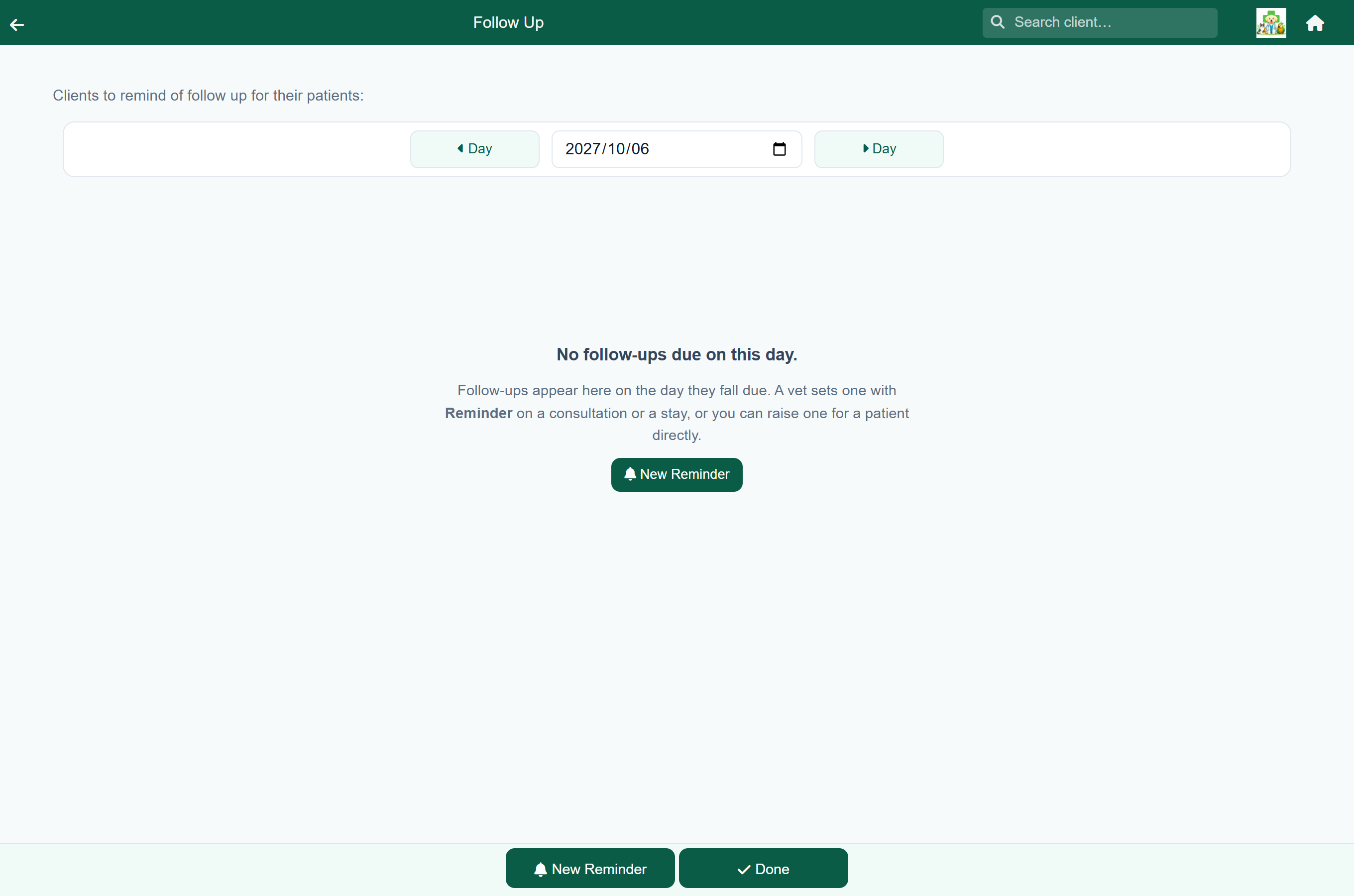
The follow-up list shows the reminders due on a day. Reminders are set during a consultation, on a hospital or boarding stay, or on the patient from the client's account.
Repeat medication also appears here when a patient on a repeat prescription is due their next supply, marked with a pill icon. This happens automatically for every prescription with a repeat interval.
A repeat card shows what is left on the prescription, for example 4 repeats left · valid to 1 Mar 2027. If it says No repeats left or Script expired, the patient needs an appointment for a new prescription.
Each card shows the patient, the owner and their number, the reminder, and what it was raised on. The word at the top right shows whether the automatic reminder message to the client was sent, for example Sent or Failed. Work through the list with these buttons:
- Book: make an appointment for the patient.
- Open: open the consultation or stay the reminder came from. On a repeat, it opens the patient's Medications. A reminder raised on the patient has no Open.
- Done: the call was made. FastVet asks what happened and saves your answer.
- Postpone: pick a new date, and the reminder moves to that day.
- Cancel: no longer needed.
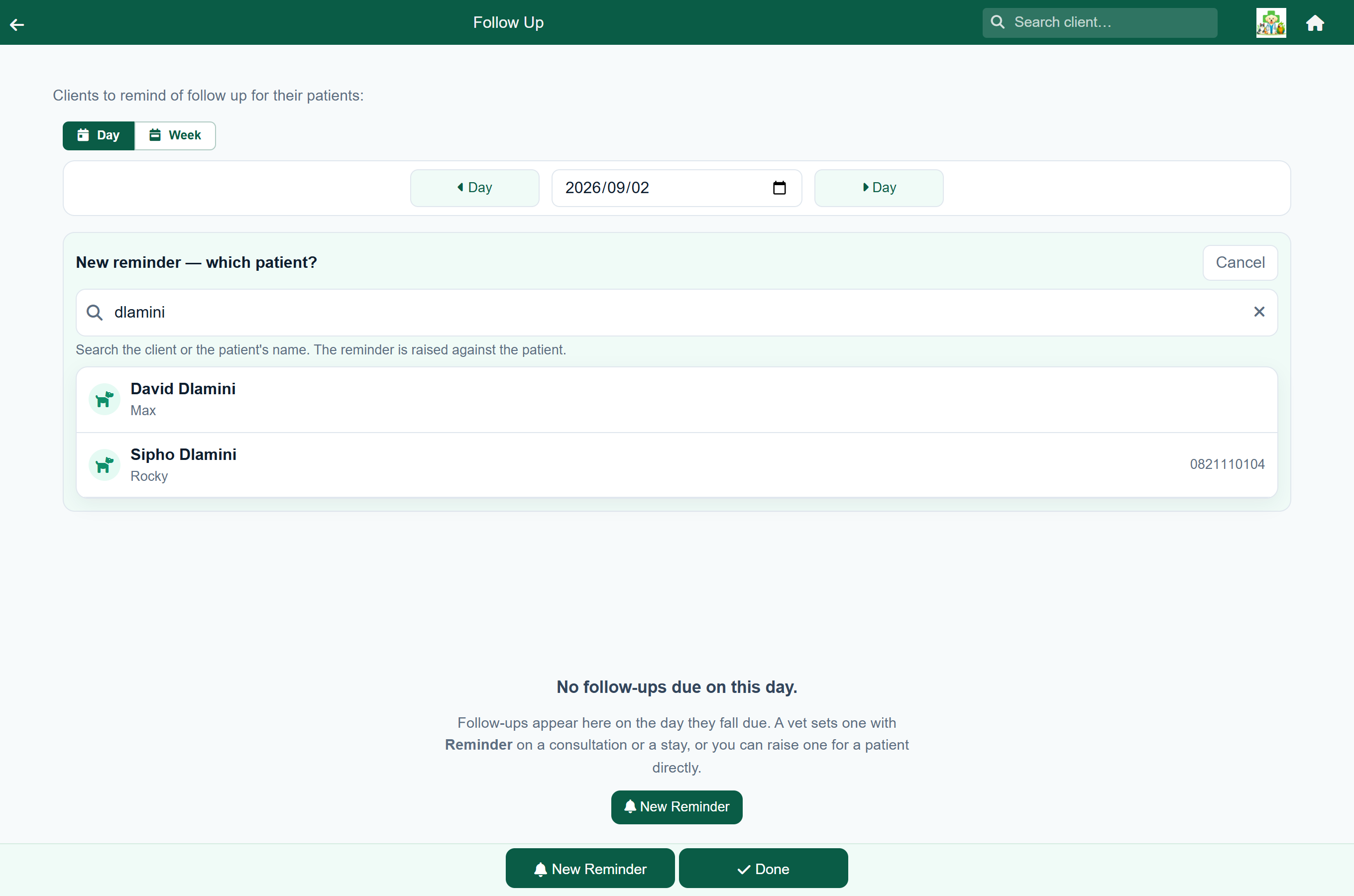
To raise a reminder yourself, press New Reminder, find the client or patient, choose the patient, and fill in the reminder form.
The follow-up week#
Home›Follow Up›Week
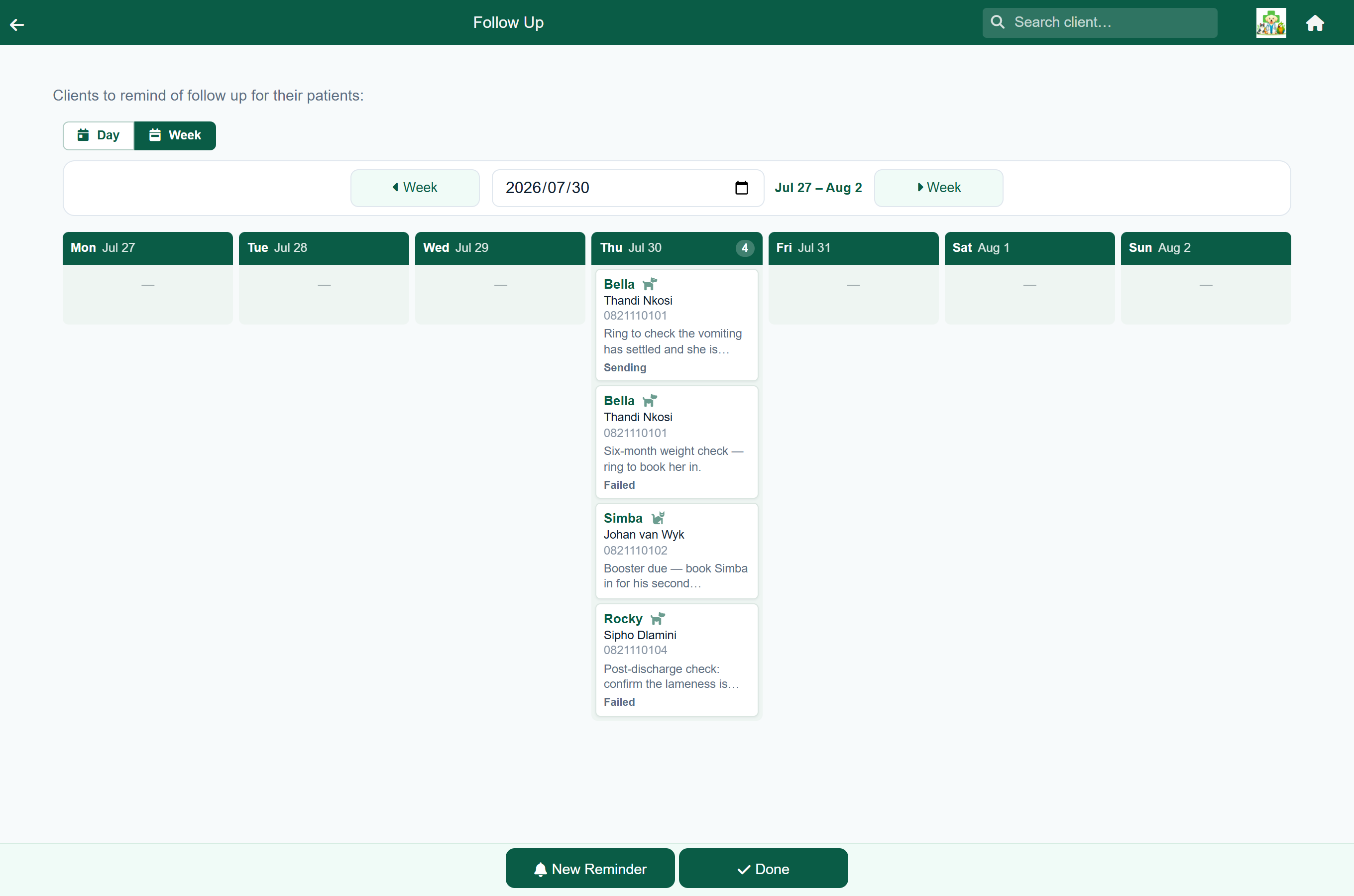
Week shows the follow-up list as a column per day, Monday to Sunday, so you can see which days are busy.
- The number in each day's heading is how many follow-ups are due that day.
- A card shows the patient, the owner, their number and the reminder. Long reminders are cut to two lines.
- Tap a card to show Book, Open, Done, Postpone and Cancel. They work as on the day view.
- Tap a day's heading to open that day.
- Use the Week buttons either side of the date to move a week, or set the date to jump.