
Help Centre › Stock & pricing
Price groups
Staff rates, senior discounts, rescue rates — a named alternative markup that whoever is charging can pick, on any item, anywhere in FastVet.
A price group is a named alternative markup. An item's everyday price is your cost plus your usual markup; a price group says “for these clients, use this markup instead”.
Practices use them for:
- Staff — buying at cost, or close to it.
- Seniors — a standing discount for pensioners.
- Rescues and charities — a reduced rate for organisations you support.
- Breeders or wholesale — volume rates.
How the price is worked out#
A price group prices the item from its cost: cost × (1 + the group's markup) + VAT. It does not discount the normal selling price — it ignores it.
For example, a dental scale and polish with a cost of R326.09 and a normal selling price of R750.00, with VAT added:
| Charged as | Markup | Sum | Client pays |
|---|---|---|---|
| Normal | — | the catalogue selling price | R750.00 |
| Seniors | 25% | R326.09 × 1.25 = R407.61, + VAT | R468.75 |
| Staff | 0% | R326.09 × 1.00 = R326.09, + VAT | R375.00 |
| Custom | — | whatever is typed | anything |
So a 0% group sells at cost and a 25% group adds a quarter to cost. You are choosing the margin, not a discount: for “20% off”, work out the markup that gives that price, or use Custom for a one-off.
Creating a price group#
Home›Settings›Price Groups
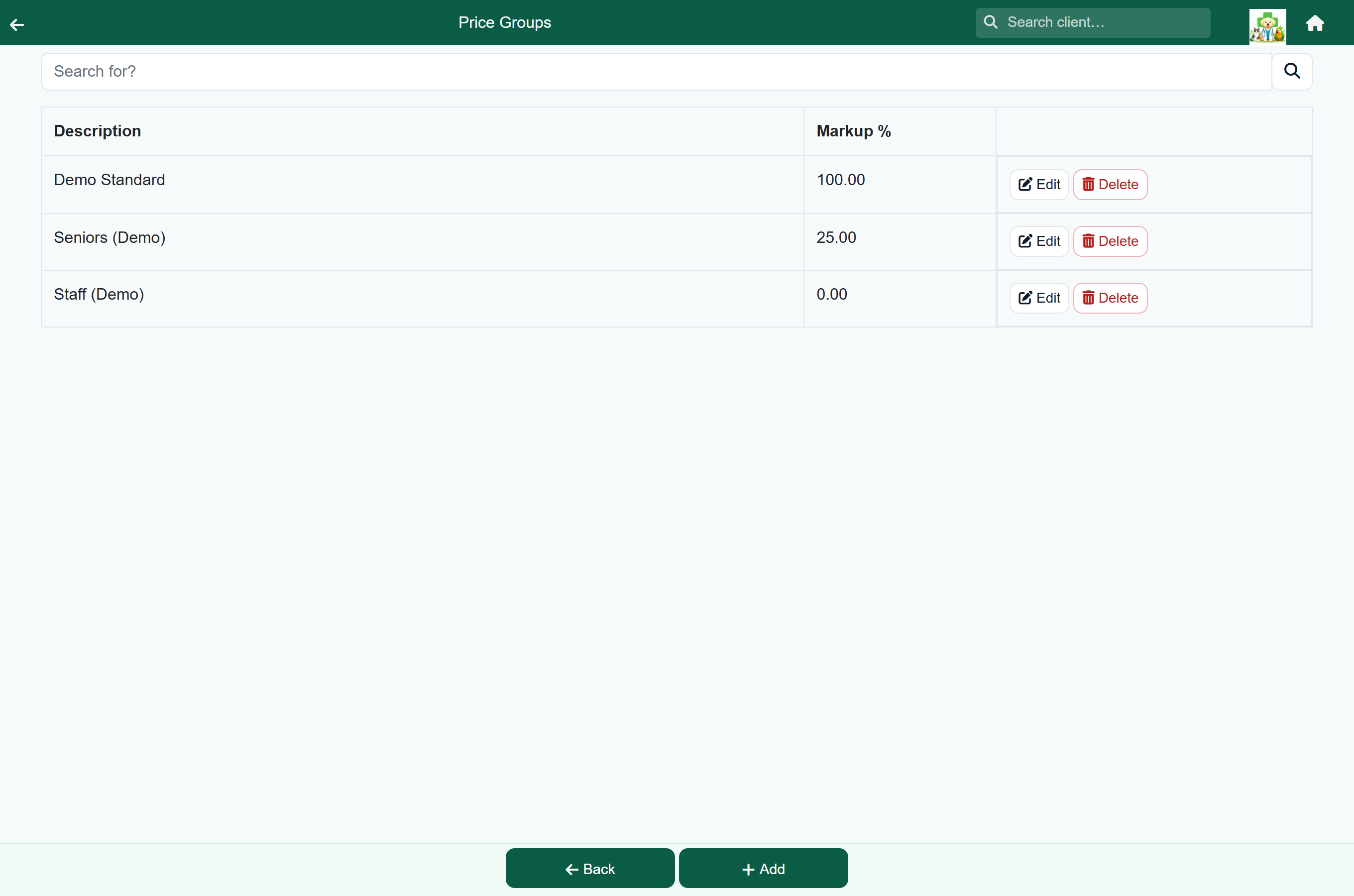
- Choose Price Groups on the Settings menu.
- Press Add.
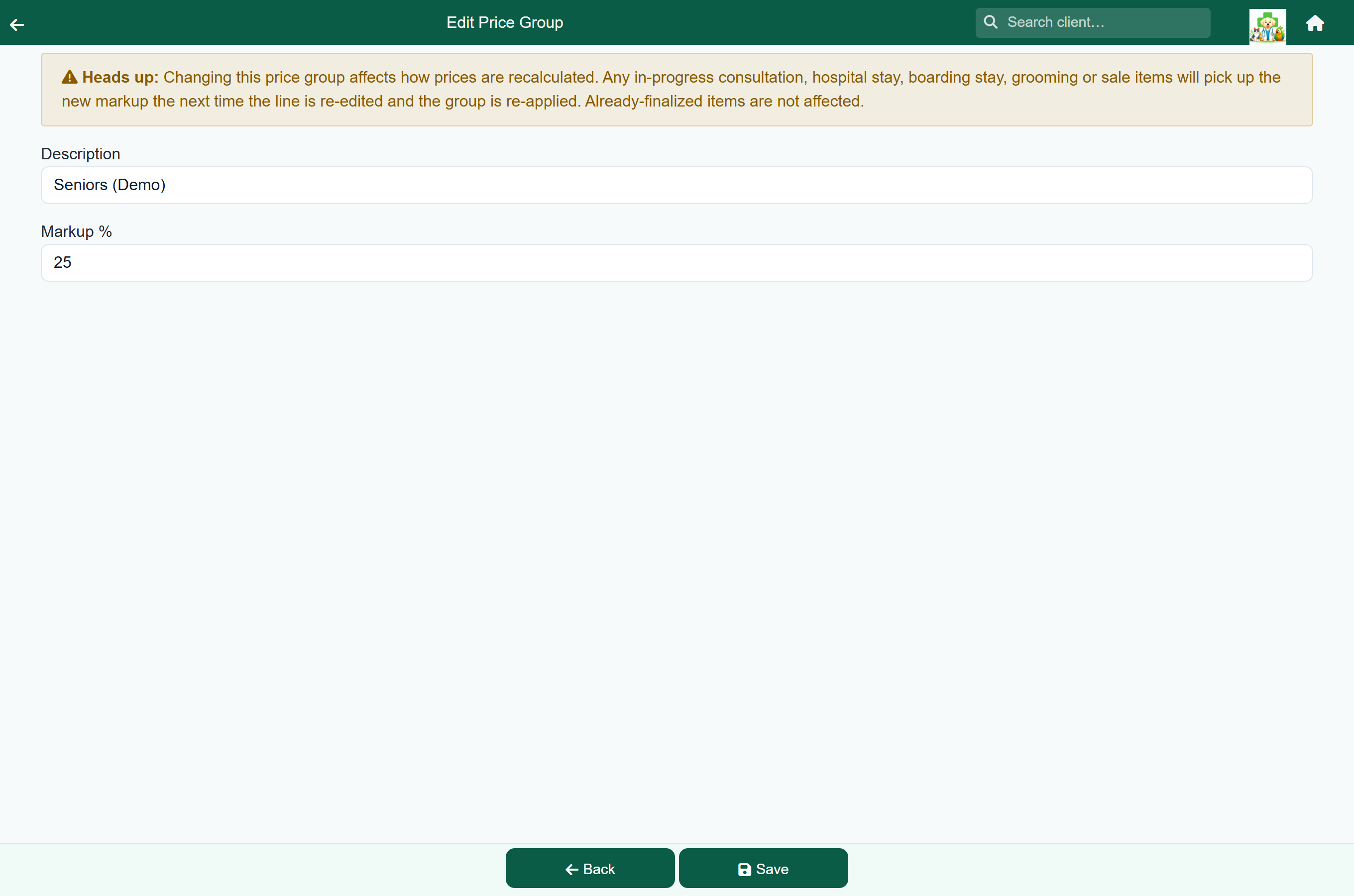
- Enter a Description — this is the label staff see on the button, so keep it short: “Staff”, “Seniors”, “SPCA”.
- Set the Markup %.
- Press Save.
Charging at a group rate#
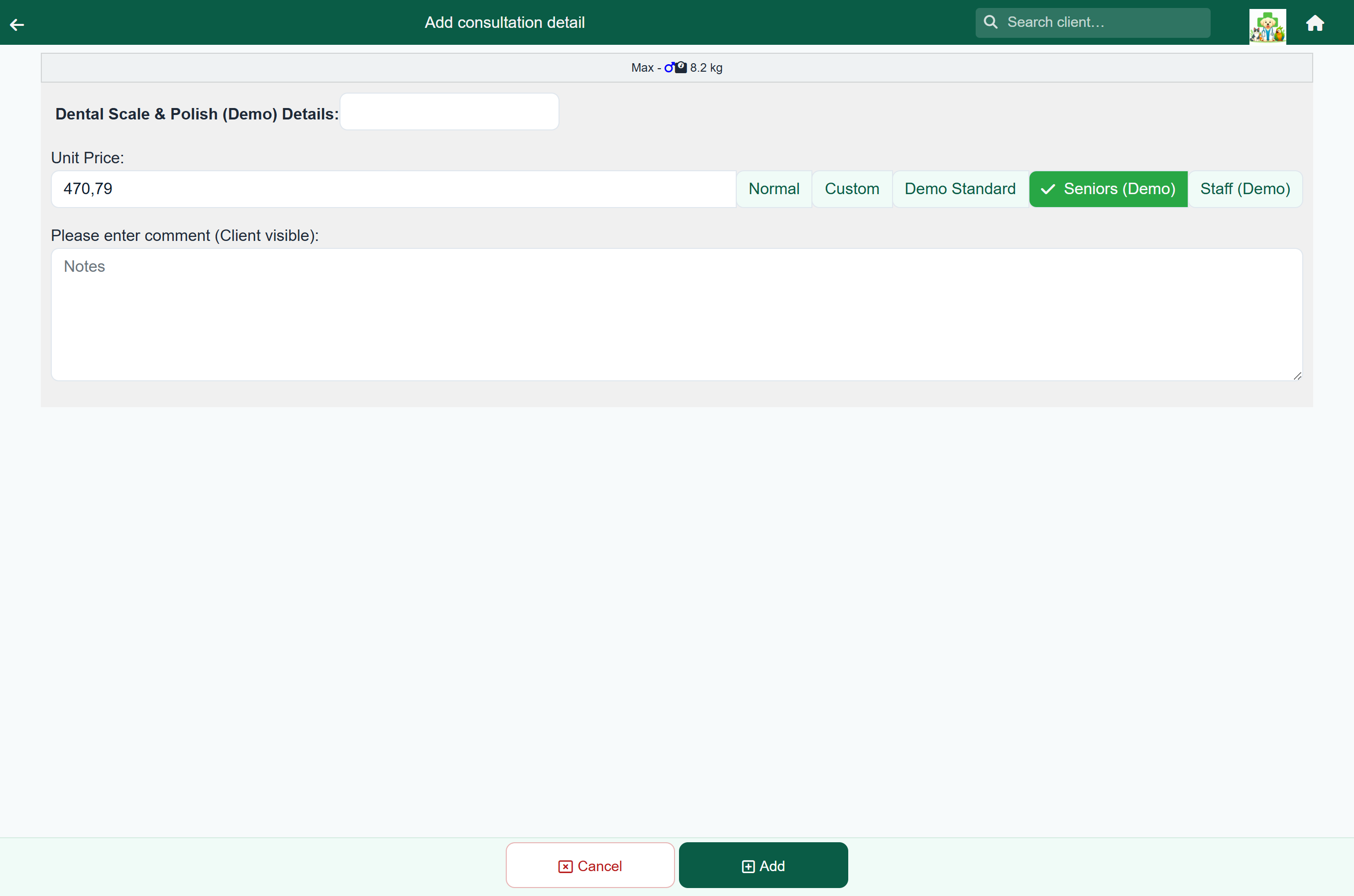
The buttons sit beside the price wherever an item is charged.
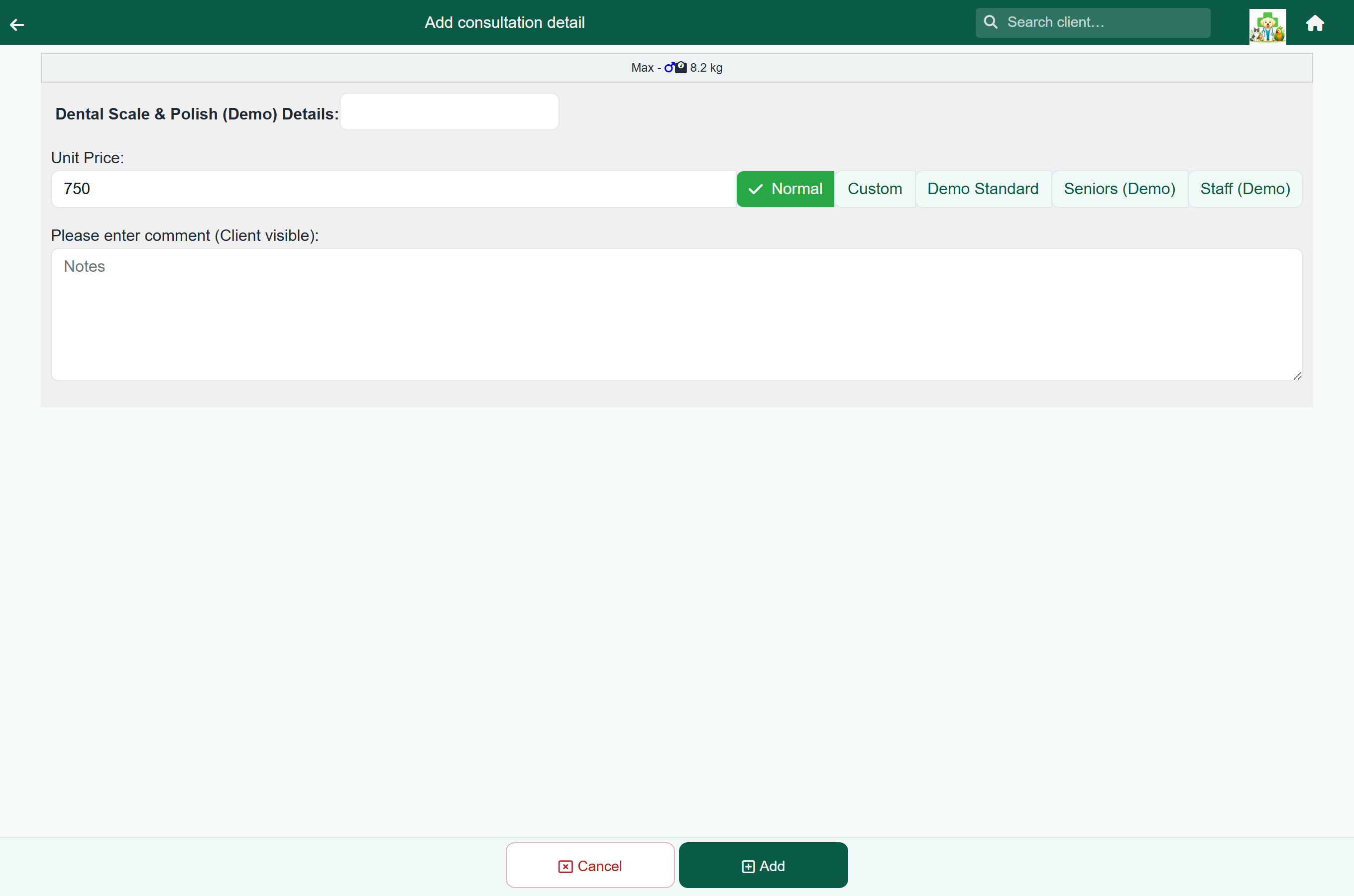
- Charge the item as usual.
- Tap the button for the rate you want. The price updates immediately.
- Press Add.
| Button | Does |
|---|---|
| Normal | The everyday catalogue price. This is the default; tap it again to go back to it. |
| Custom | Lets you type the price for this one charge. |
| Each price group | Prices the item from cost at that group's markup. |
The buttons appear everywhere FastVet charges an item:
- Consultation items, and the Protocol Charge.
- Counter sale items.
- Hospital and boarding day items.
- Grooming items.
- Quote lines.
Giving a client a standing rate#
To put a client on a rate permanently, open their record and, under Account, set Default Rate to the price group. Every new line on a consultation, a hospital or boarding day, a groom or a quote is then priced at that rate, and the item says “Charged at group, this client’s usual rate.”
| Question | Answer |
|---|---|
| Does it apply to every line? | Every new line on those screens. Staff can still tap a different button on any line. |
| Does it change lines already charged? | No. A charged line keeps its price, and reopening it shows the button it was charged at. |
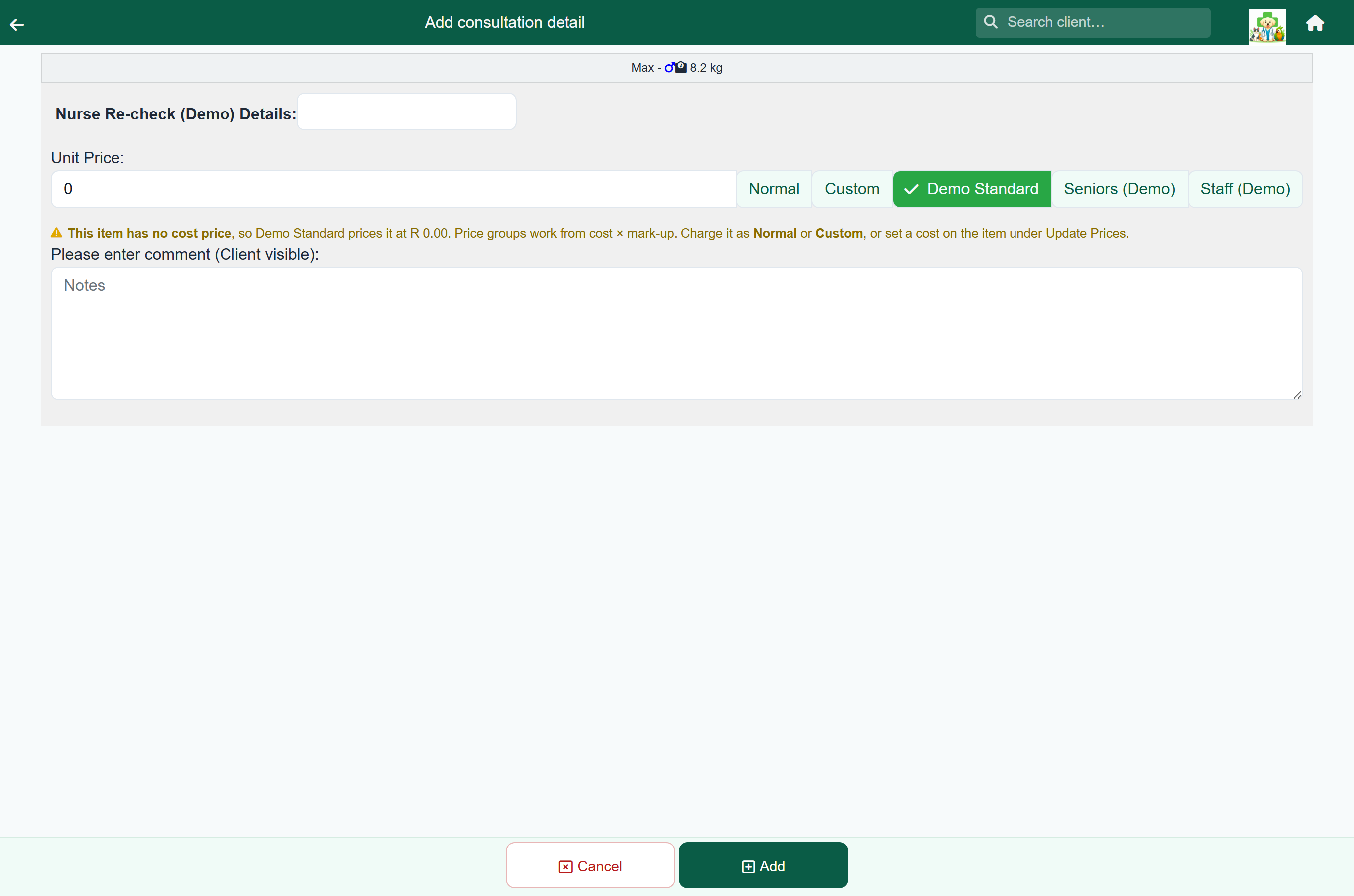
| What about an item with no cost price? | It is left at its normal price, so it is not charged at R0.00. |
| Does the client see which rate they got? | No. The invoice shows the amount, not the group. |
| Can a client be on a rate for some visits and not others? | The rate applies to all of them. For a one-off, change the line. |
Seeing what you gave away#
There is no report of discounts given by price group. To keep an eye on what a rate costs you:
- Compare the category summary report month to month.
- Compare the stock used report against income, for product-heavy discounting.
- Review the group's markup from time to time, as you would any other price.
Before you rely on them#
- Cost prices are filled in on the items you expect to discount. No cost means R0.00.
- The names are clear on a button.
- There are only a few groups.
- Clients who always get a rate have it set as their Default Rate.
- The markup is reviewed like any other price.