
Help Centre › Reports
Reports
Every report FastVet has: what question each one answers, where its numbers come from, when to run it, and which of them your accountant can have as a spreadsheet.
FastVet's reports answer three kinds of question — what happened today, what is the money doing, and what moved through the shelves. Each one below says what it is for, where its figures come from, and what to watch for. None of them changes anything: a report is safe to open.
Where they live#
The two run daily have their own tiles on Home. Everything else is behind Reports.
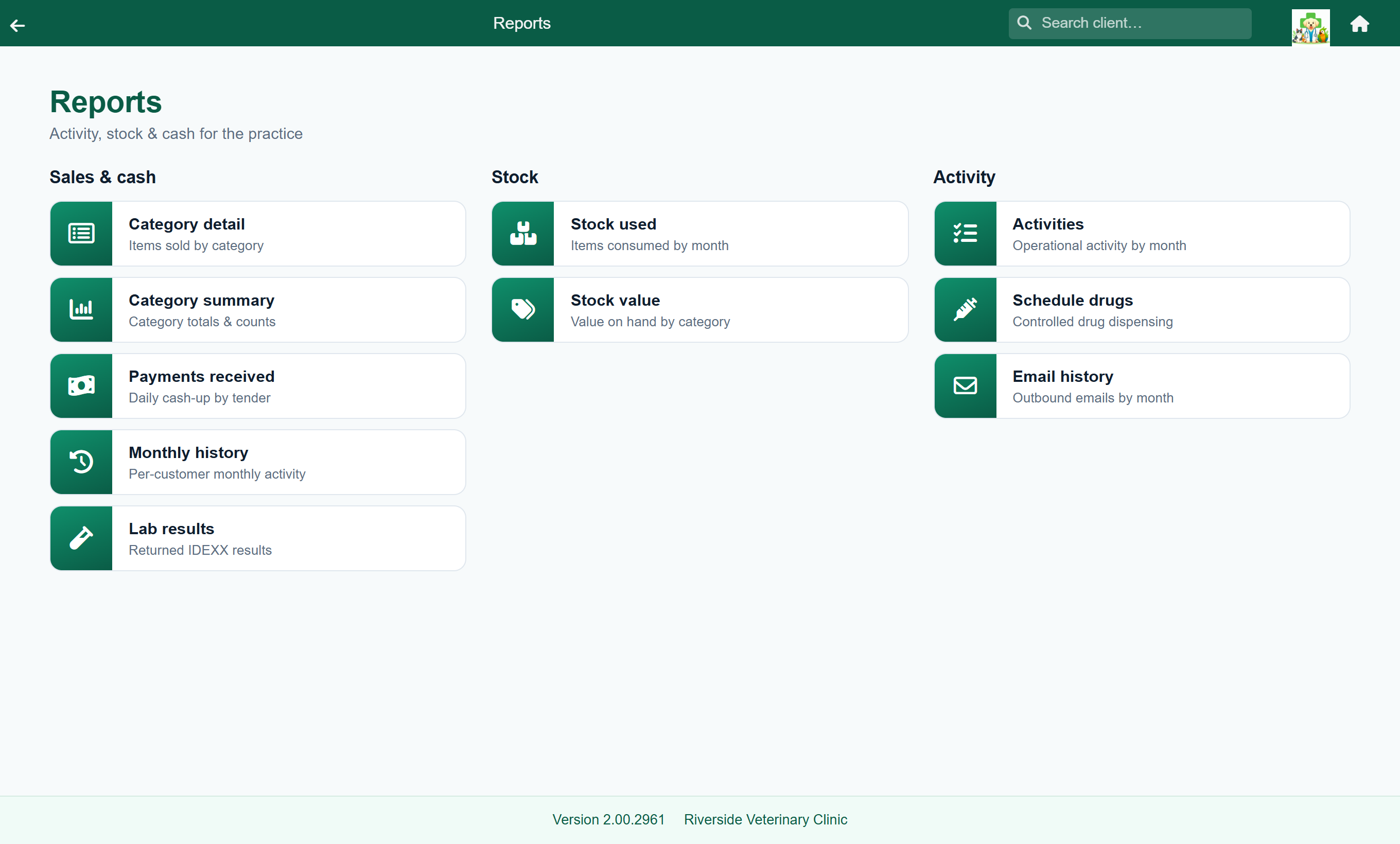
| On Home | Behind Reports |
|---|---|
| Daily summary Account book | Payments received · Payments received (detail) Debtors age analysis · VAT summary Monthly history · Category detail · Category summary Invoice register · Credit notes Gross profit · Top clients · Top products Activities · Stock used · Stock value Expiring stock · Stock to order · Schedule drugs Repeats due · Refill requests · Clients by tag Lab results · Email history · Accounting export (Admin) |
Choosing the period#
Reports choose their period in one of these ways:
| Control | On | Behaves |
|---|---|---|
| A day picker, with arrows either side | Daily summary | Opens on today. The arrows step a day at a time. |
| A day picker, labelled Day, that will not go past today | Stock value Debtors age analysis | Opens on today. Picks the day to report the position at the close of — a position, not a period. |
| A From and To pair, with a Period menu and arrows either side | Most of the rest | Opens on this month so far. Pick any two dates, or use the Period menu for this or last month, this or last quarter, or year to date. The arrows step by whatever length you have chosen — a month-long period moves a month, a quarter moves a quarter. Both dates you pick are included. |
| A month picker, with Month arrows either side | Monthly history | Opens on this month. |
| A From and To pair, with no menu | Lab results | Opens on the last 30 days. |
| Daily / Weekly / Monthly, then a picker | Payments received | Opens on Daily — today only. |
| None | Expiring stock Stock to order Repeats due | Always shows the position now. |
Narrowing a report to tagged clients#
Seven reports take a Tags filter beside the period. It narrows the report to clients carrying the tags you pick. The columns, totals and export stay the same, over fewer people.
| Reports with a Tags filter |
|---|
| Debtors age analysis · Invoice register · Credit notes · Payments received (detail) · Top clients · Repeats due · Email history |
Press a tag to include it, and press it again to drop it. Clear takes them all off. The report runs again each time.
Opening what a row is about#
On most reports you can press a row to open what is behind it.
| On | Pressing a row opens |
|---|---|
| Invoice register | The document that raised the charge — the consultation, sale, hospital stay, boarding stay or groom. A row with no document, such as interest, opens the client's account. |
| Debtors age analysis · Top clients Payments received (detail) · Credit notes Account book | The client's account, with the charges and payments behind the figure. |
| Repeats due · Email history | The client's record — contact details and pets. |
| Lab results | The consultation, or the hospital or boarding day, that the result belongs to. |
| Gross profit · VAT summary | Its breakdown, in the same table: a category opens in place into its subcategories, and a subcategory into its items. Press it again to close it. |
| Payments received | A type in the summary narrows the payment details below it to that type. Press it again, or Show all, to see every payment. |
| Daily summary · Monthly history | Use the arrow buttons on the line: the one by the name opens the client's account, the one by the description opens the document. |
Daily summary#
Home›Daily Summary
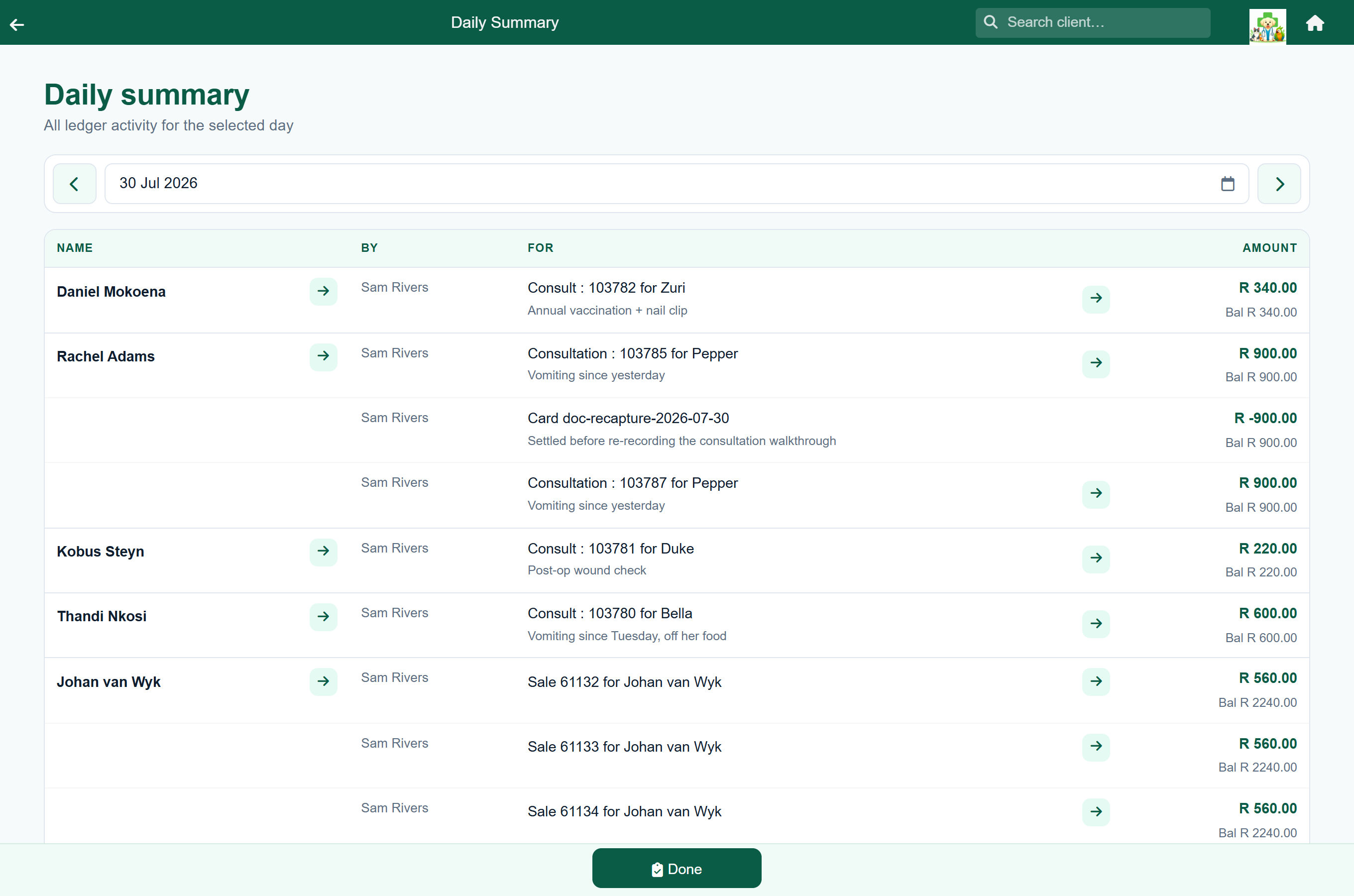
| Answers | “What happened on the books today?” |
| Reads | The customer ledger — every charge and every payment posted on that date. |
| Run it | At close of play, before you cash up. |
One line per ledger entry, grouped by client: who it was, who did it, what it was for — the consultation number, the patient, the reason for the visit — and the amount. Under the amount is the client's current balance. Payments show as negatives. The arrows open the client's account or the document behind the line.
Use this report to reconcile the till, and to check the individual entries when a figure on another report looks wrong.
Account book#
Home›Account Book
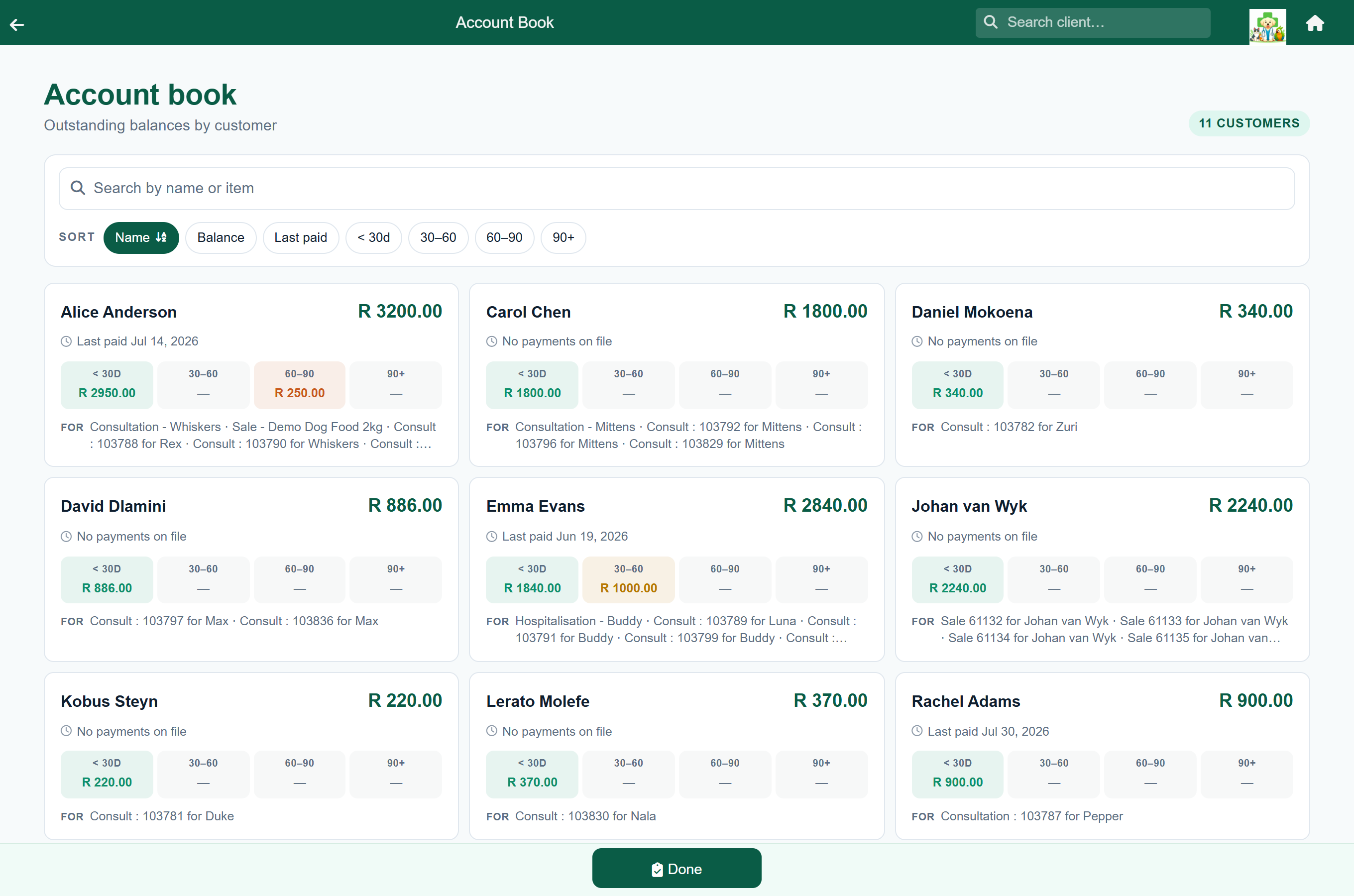
| Answers | “Who owes us money, how long have they owed it, and who do I chase first?” |
| Reads | The customer ledger, totalled per client. Only clients owing more than R1 appear. |
| Run it | Weekly, and before any statement run. |
One entry per client: what they owe, when they last paid, the debt split into under 30 days, 30–60, 60–90 and 90+, and a FOR line naming the visits and sales that make it up. In the mint theme each client is a card with the older amounts tinted; in the classic theme it is a table row.
- Sort by 90+ to bring the worst debt to the top.
- Read the FOR line — it often explains the debt without opening anything.
- Open the client to see the entries, take a payment, or send a statement.
What the ageing buckets mean when they turn up elsewhere in the app is covered under the 60 and 90 day badges.
Debtors age analysis#
Home›Reports›Debtors age analysis
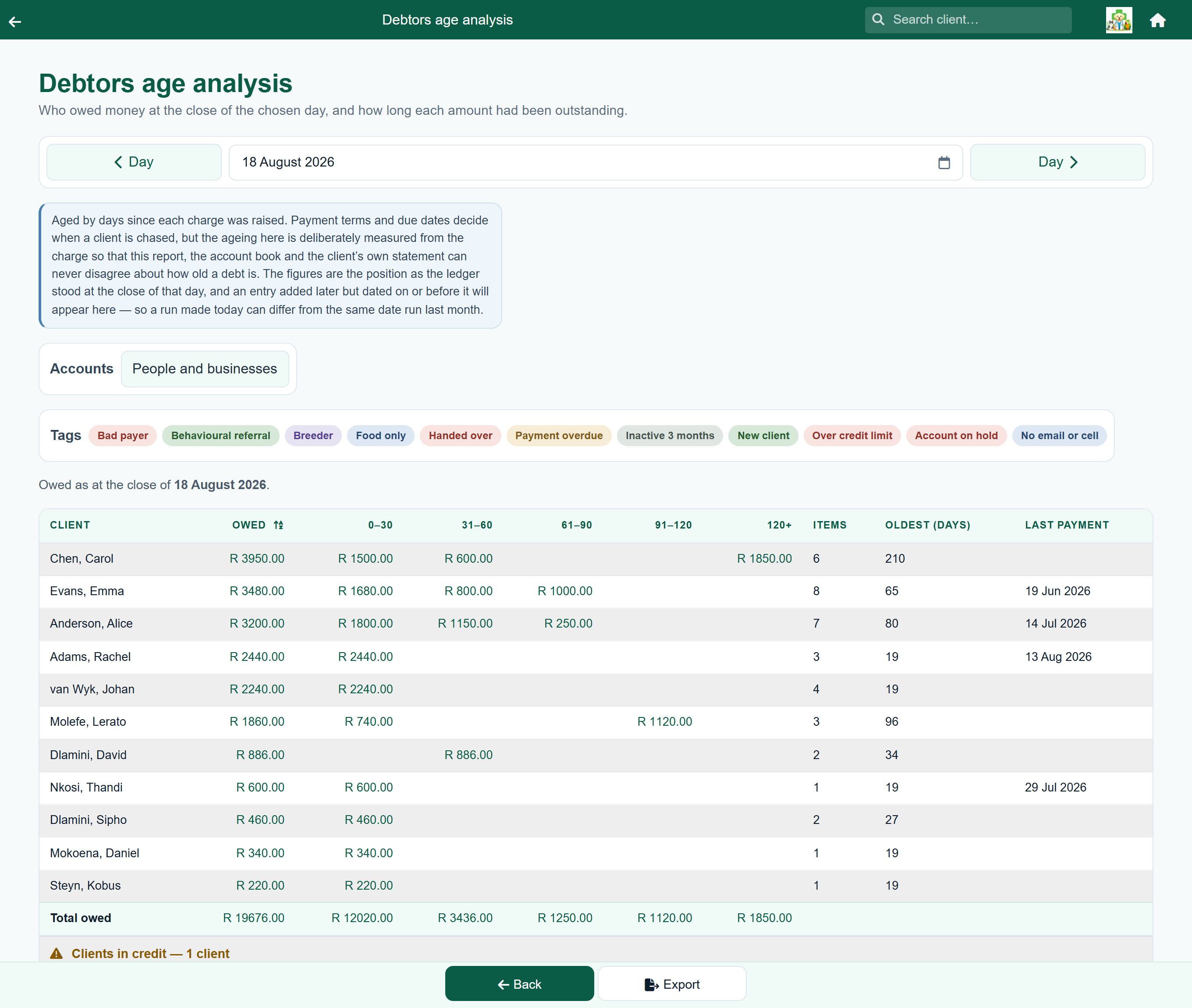
| Answers | “What was owed on this day, who owed it, and how long had they owed it?” |
| Reads | The customer ledger, replayed back to the day you pick. |
| Run it | Year-end and month-end, and any time your accountant asks for debtors at a date. |
One row per client: what they owed, then that amount split into 0–30, 31–60, 61–90, 91–120 and over 120 days, then how many charges make it up, how old the oldest one is, and when they last paid. An empty bucket is left blank so the money stands out. Every money column totals at the foot, and the figure beside Total owed is the practice's debtors on that day.
Accounts narrows it to people or to businesses. The two always add up to the unfiltered total, because every client is one or the other.
Pick the day with the Day arrows or the date box. The report opens on today, where it agrees with the account book client for client. Stepping back re-answers the question for that day: it replays the ledger as it stood at the close of it, so a charge raised in March and paid in June is outstanding on an April report and gone from a July one.
Age is counted from the day each charge was raised, not from a due date or the client's payment terms. A consultation on the 3rd is 28 days old on the 31st. This report, the account book and the client's statement all count age the same way.
Reversed charges drop off from the day they were reversed. A charge you reversed last week was still owed the week before, so it shows on a report for any earlier day.
Clients in credit get their own section at the foot of the table, with their own total. They are not subtracted from the total above: money on a client's account is owed to them.
Payments received#
Home›Reports›Payments received
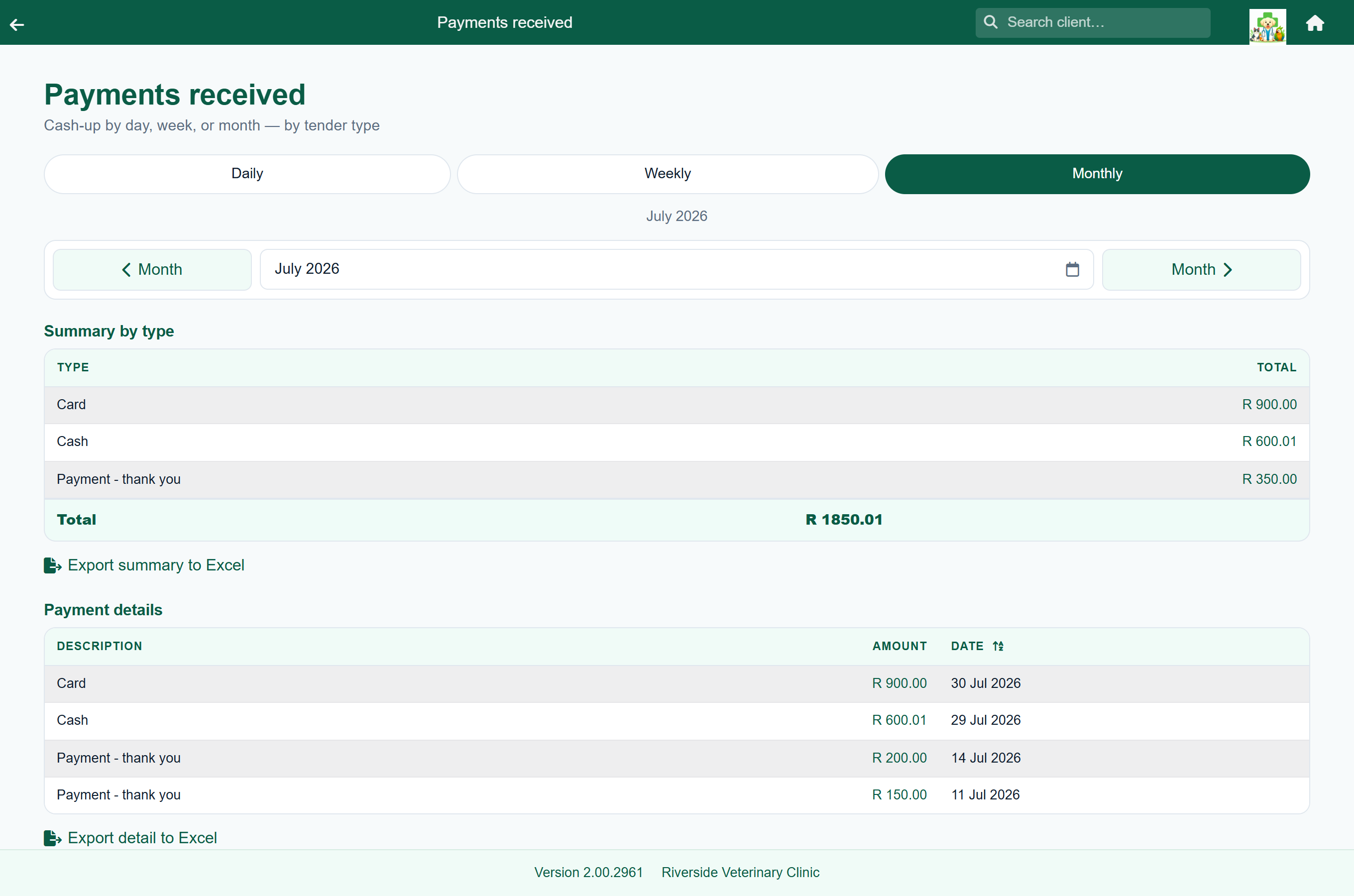
| Answers | “What did we actually take, and in what form?” |
| Reads | Receipt entries on the customer ledger — money in, nothing else. |
| Run it | Daily for the cash-up; monthly for the bank reconciliation. |
Payments are grouped by date and description, and the description is the tender type reception chose when taking the money — Cash, Card, EFT. If many payments just say “Payment”, you cannot reconcile the card machine against it.
Daily, Weekly and Monthly change the period. Weekly and Monthly also show a Summary by type above the payment details — the totals you reconcile against.
Click a type in the summary to show only its payments in the details below — say, every card payment to check against the card machine. Click it again, or Show all, to see every payment. Export detail exports what is showing.
The footer has two exports: Export summary for the summary by type (Weekly and Monthly only), and Export detail for every payment line.
Payments received (detail)#
Home›Reports›Payments received (detail)
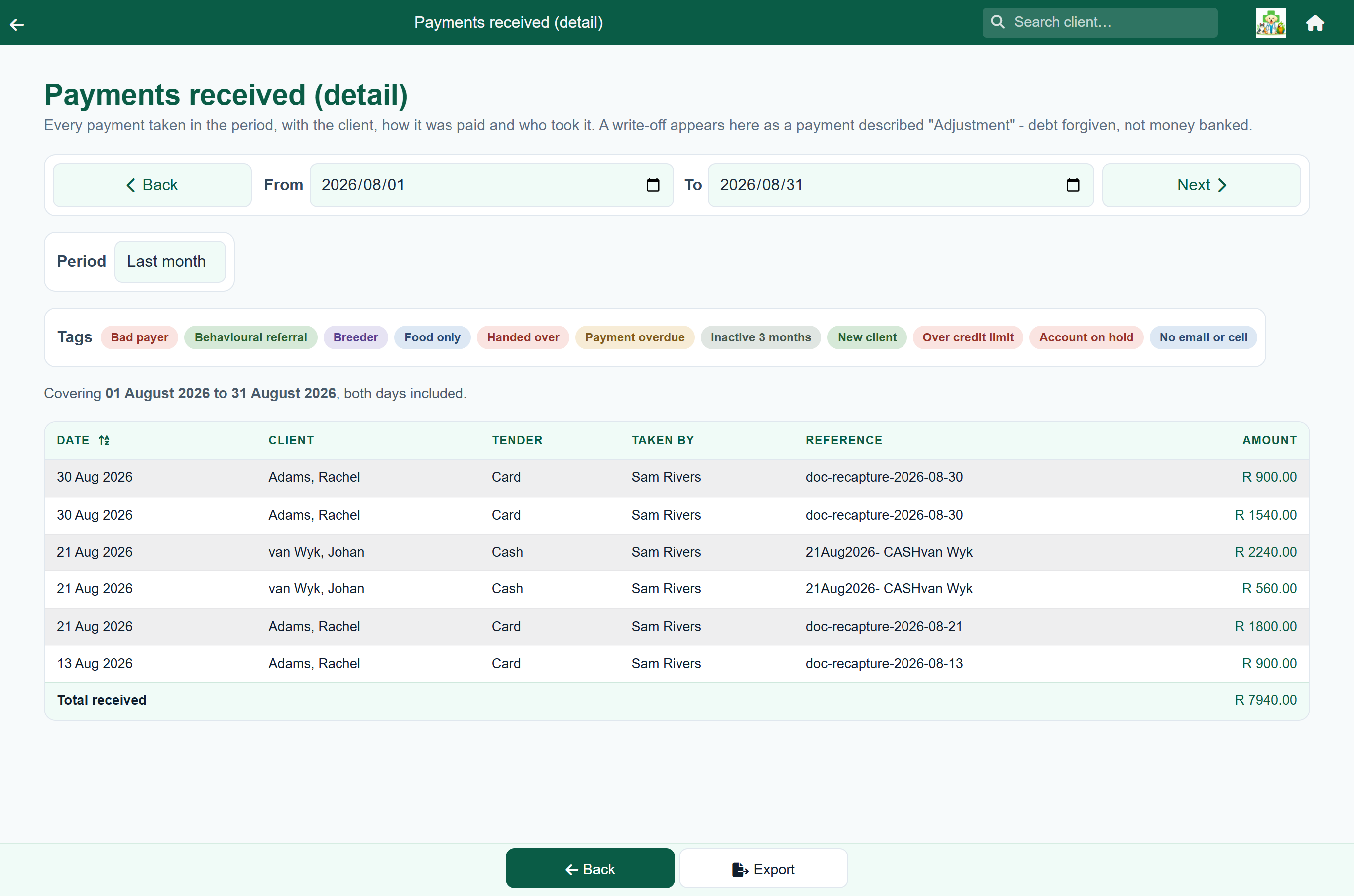
| Answers | "Which payment was that, who made it, and who took it?" |
| Reads | Receipt entries on the customer ledger, one row each. |
| Run it | When a figure on the cash-up needs tracing back to a person. |
The same money as Payments received, but one line per payment instead of one line per tender type, and carrying the two things the summary cannot show you: which client the payment was put against, and who took it. Use the summary to cash up, and this one to find a single payment.
VAT summary#
Home›Reports›VAT summary
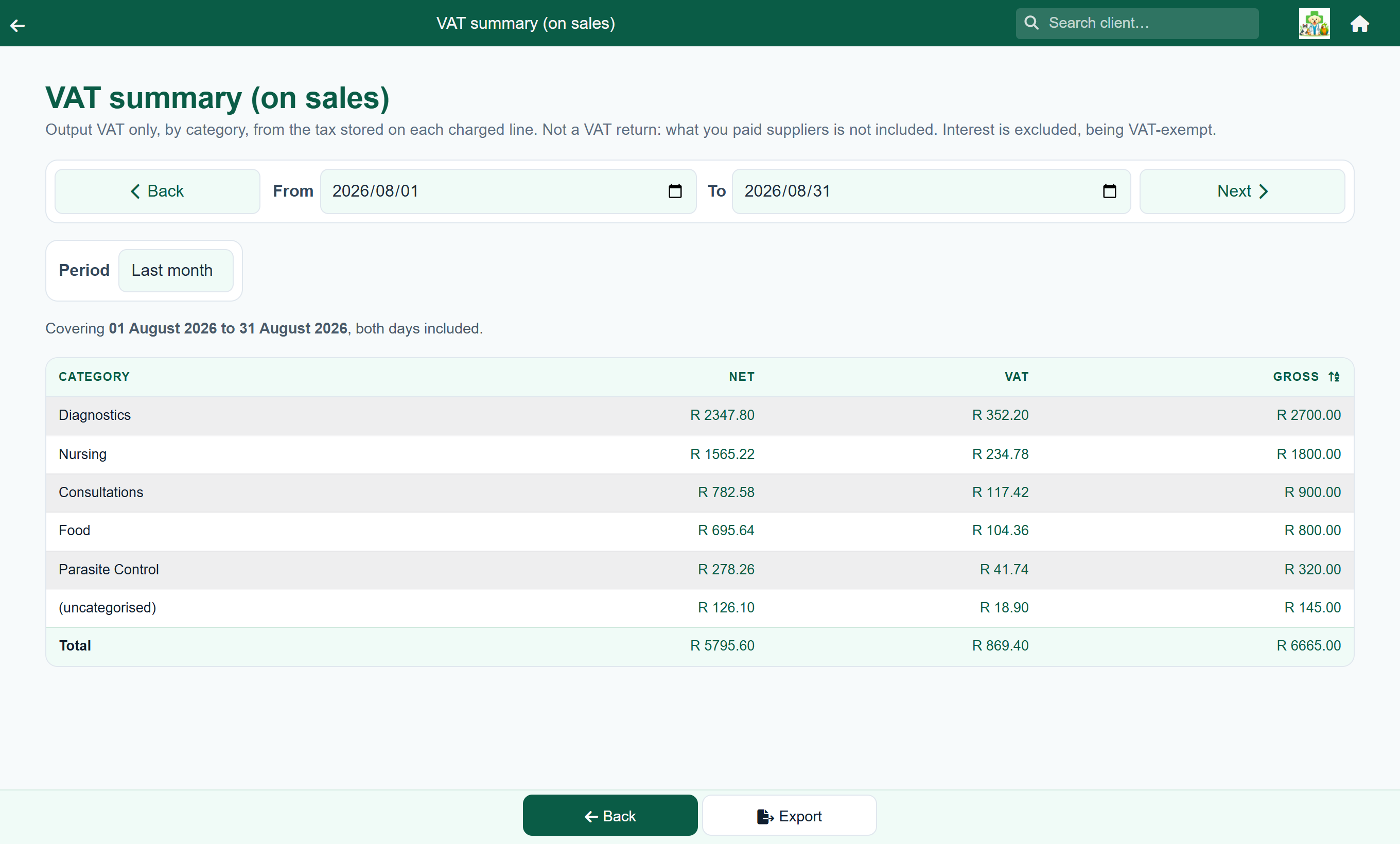
| Answers | "How much tax did we charge, and on what?" |
| Reads | The tax split stored on every charged line, totalled per category. |
| Run it | At the end of each tax period, before you send anything to your accountant. |
Net, tax and gross per category, with a total. The figures use the tax stored on each line when it was charged, so a zero-rated item stays at zero and the report agrees with your Accounting export.
Click a category to open it into its subcategories, and a subcategory to see the items in it. Each level adds up to the row above it. Click the row again to close it. Sorting a column sorts every opened level, and Export includes the rows that are open.
Invoice register#
Home›Reports›Invoice register
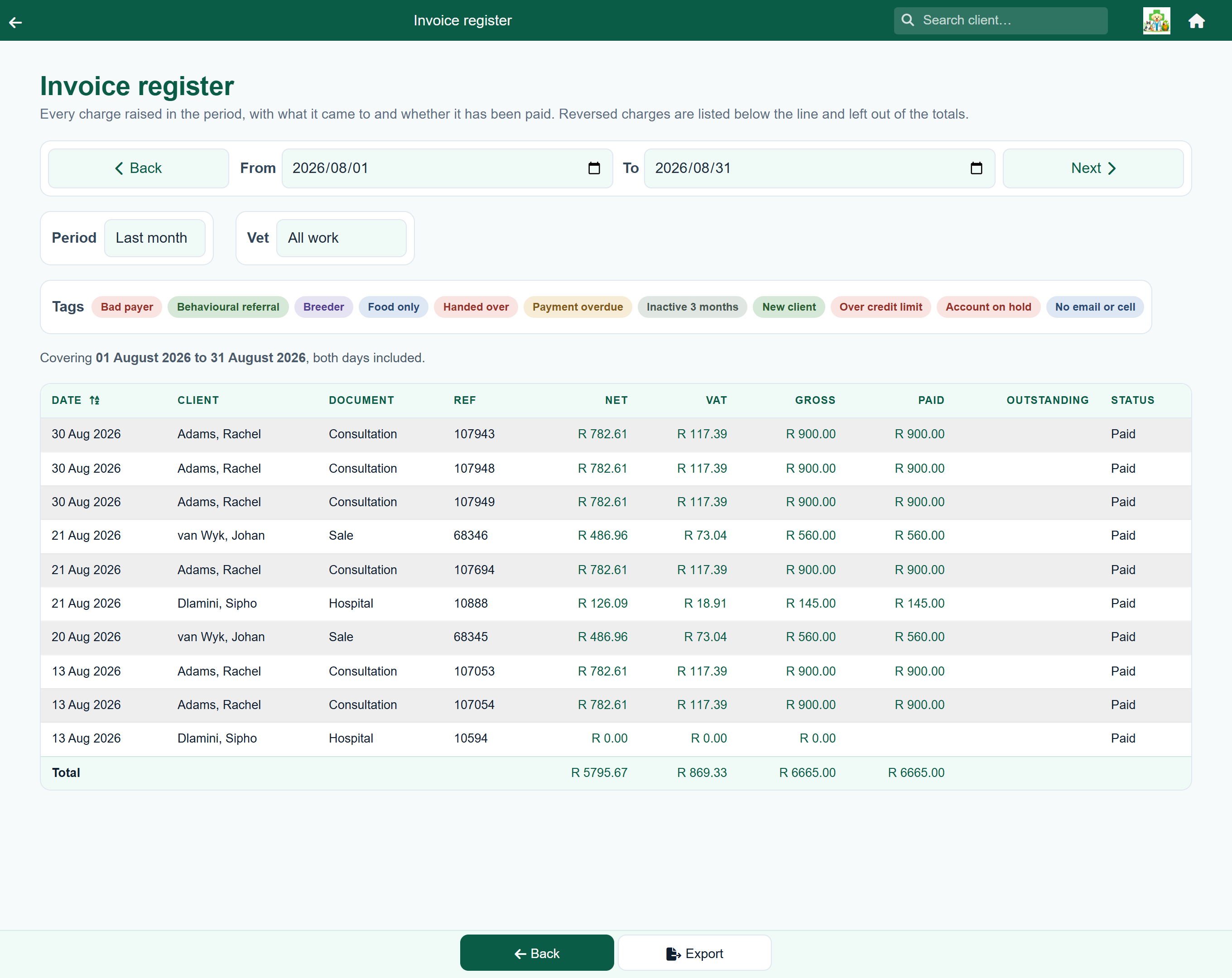
| Answers | "What did we charge, and what is still owed on it?" |
| Reads | Every charge on the customer ledger, with its stored tax and settlement. |
| Run it | Month-end, and whenever an accountant asks for the sales listing. |
One line per charge: the date, the client, which kind of document it was and its number, then net, tax and gross, what has been paid, what is outstanding, and a status. This is the report to hand over when somebody asks for "all the invoices for the period".
| Status | Means |
|---|---|
| Paid | Settled in full. |
| Part paid | Some money has been paid against it, but not all. |
| Outstanding | Nothing has been paid against it yet. |
| Reversed | The charge was voided. Listed below the line and not in the totals. |
The Vet menu narrows it to one vet's work. Shop sales and grooms are left out when you pick a vet, because they have no vet. Leave it on All work to see the practice's whole turnover.
Credit notes#
Home›Reports›Credit notes
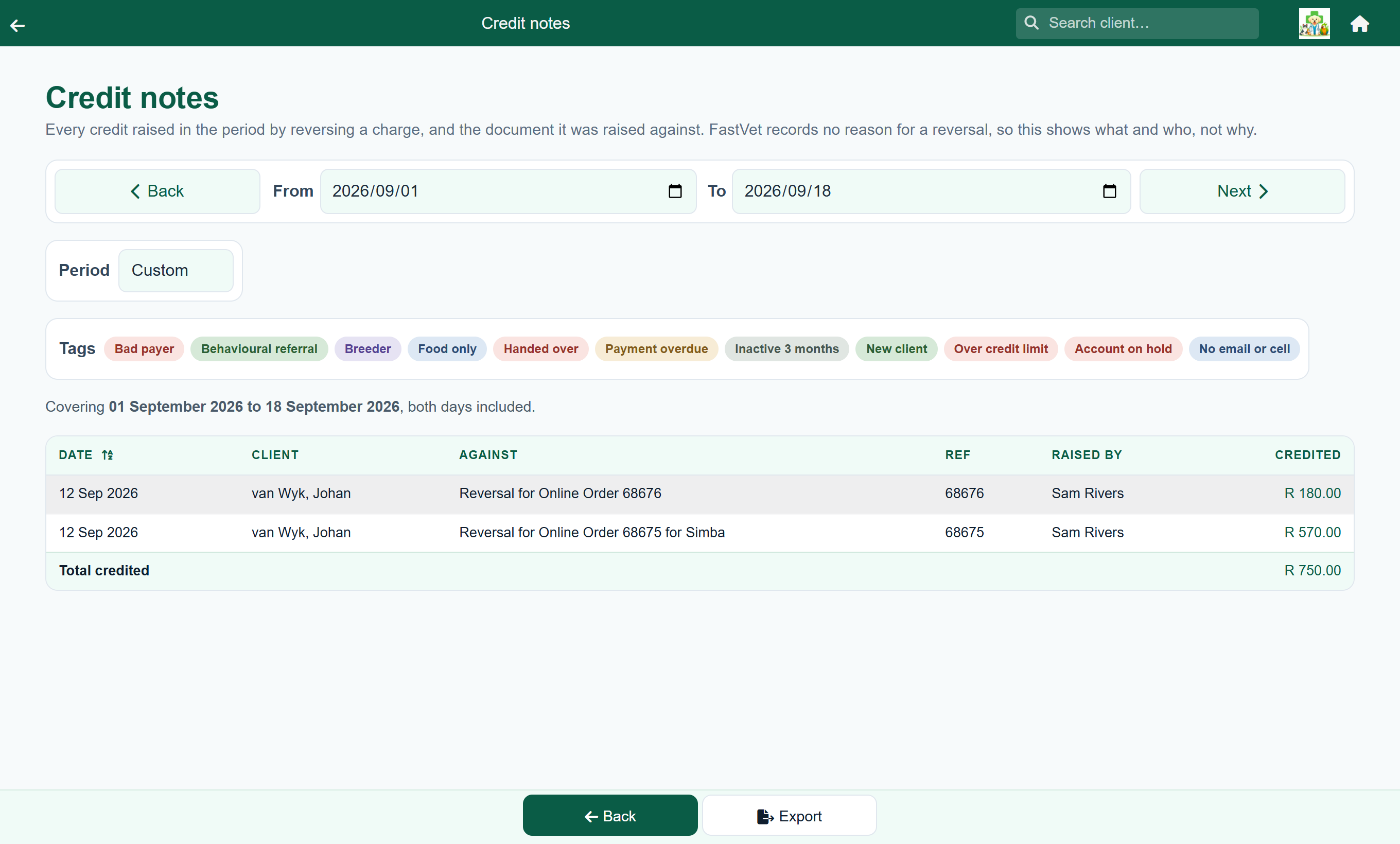
| Answers | "What did we credit back, to whom, and who did it?" |
| Reads | The credit raised each time a charge is reversed. |
| Run it | Monthly, and any time the credits look higher than usual. |
When you reverse a consultation, sale, stay or groom, FastVet credits the client and marks the original charge as reversed. That pair is the credit note, and this lists it: the date, the client, the document it was raised against, who raised it, and how much.
Gross profit#
Home›Reports›Gross profit
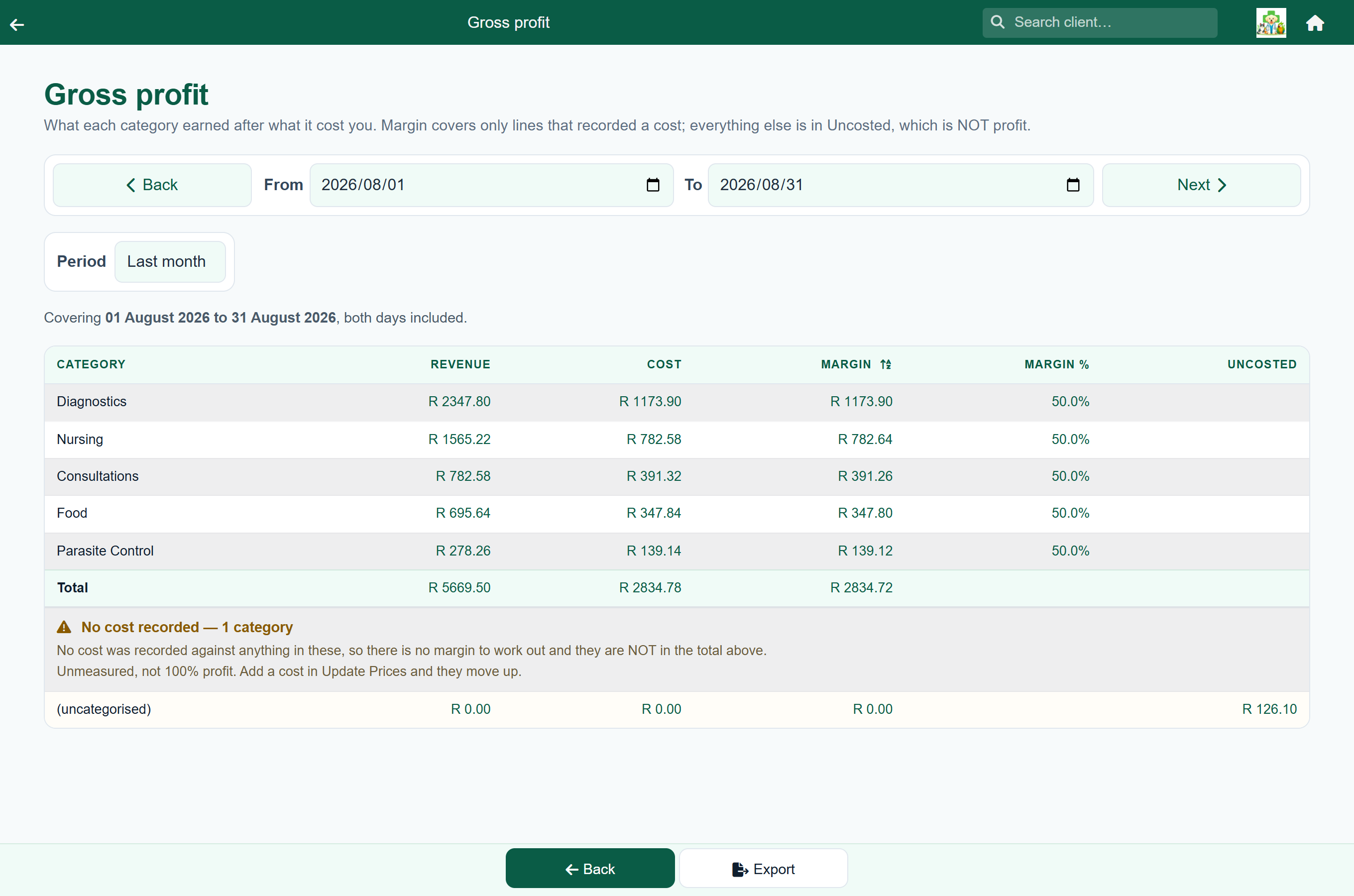
| Answers | "What do we actually keep, and on what?" |
| Reads | Every charged line, against the cost recorded on it at the time. |
| Run it | Quarterly, and before a price review. |
Revenue, cost and margin per category, all excluding VAT, because cost prices are held without VAT.
Click a category to open it into its subcategories, and a subcategory to see the items in it, each with its own revenue, cost, margin and uncosted figures. Each level adds up to the row above it. Click the row again to close it.
Categories where nothing recorded a cost are listed separately at the foot of the table, under No cost recorded, and are not part of the total. Usually that is services. If a category of stock you sell is there, its items have no cost price. Open it to see which items they are, then add the cost under Update Prices and they move up into the figures.
Top clients#
Home›Reports›Top clients
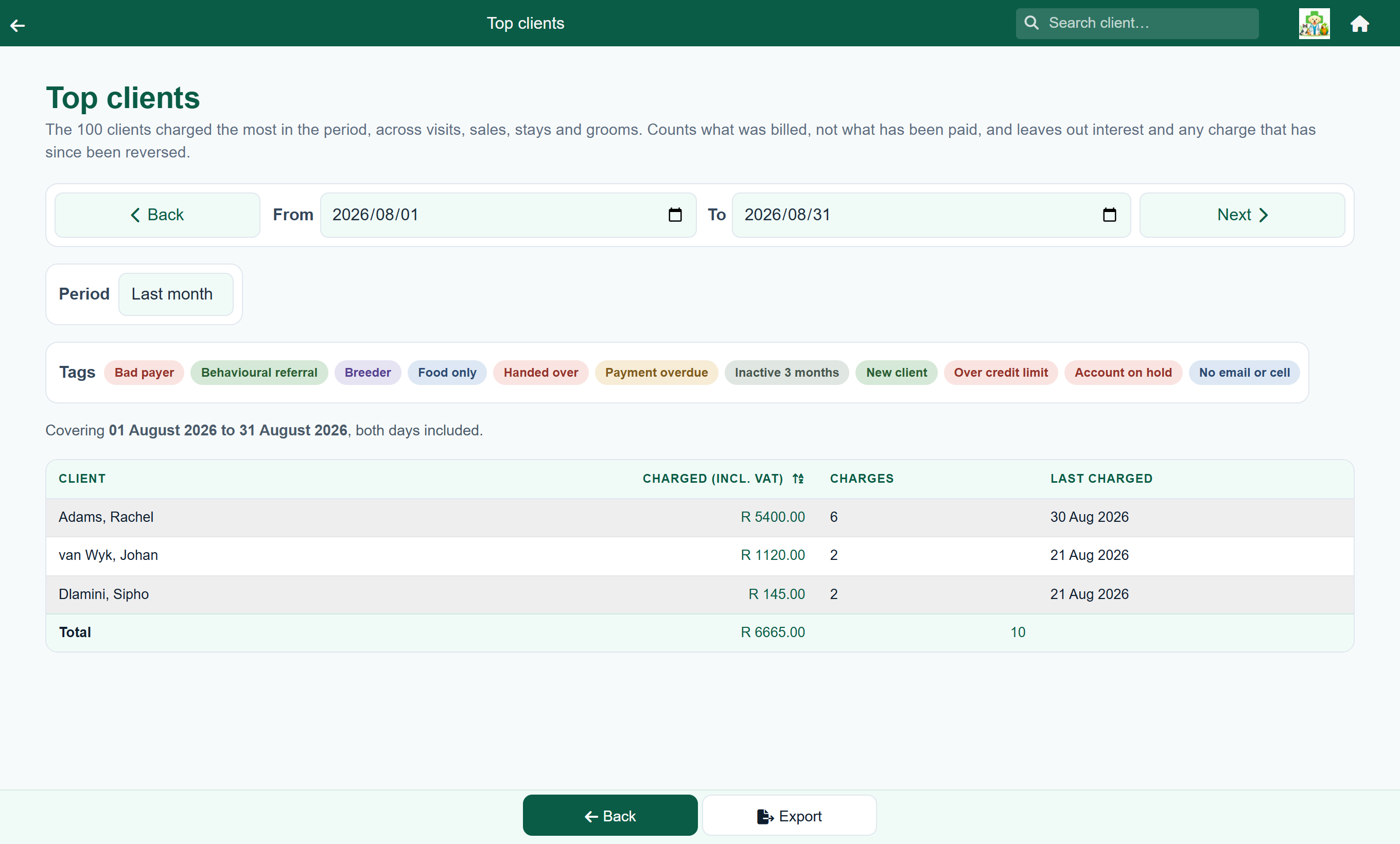
| Answers | "Who are our best clients?" |
| Reads | Charges on the customer ledger, totalled per client. |
| Run it | Quarterly, or before anything you are planning to send to clients. |
The hundred clients charged the most in the period, with how many times they were charged and when they last were. It counts what was billed, not what has been paid, and leaves out interest and any charge that has since been reversed.
Top products#
Home›Reports›Top products
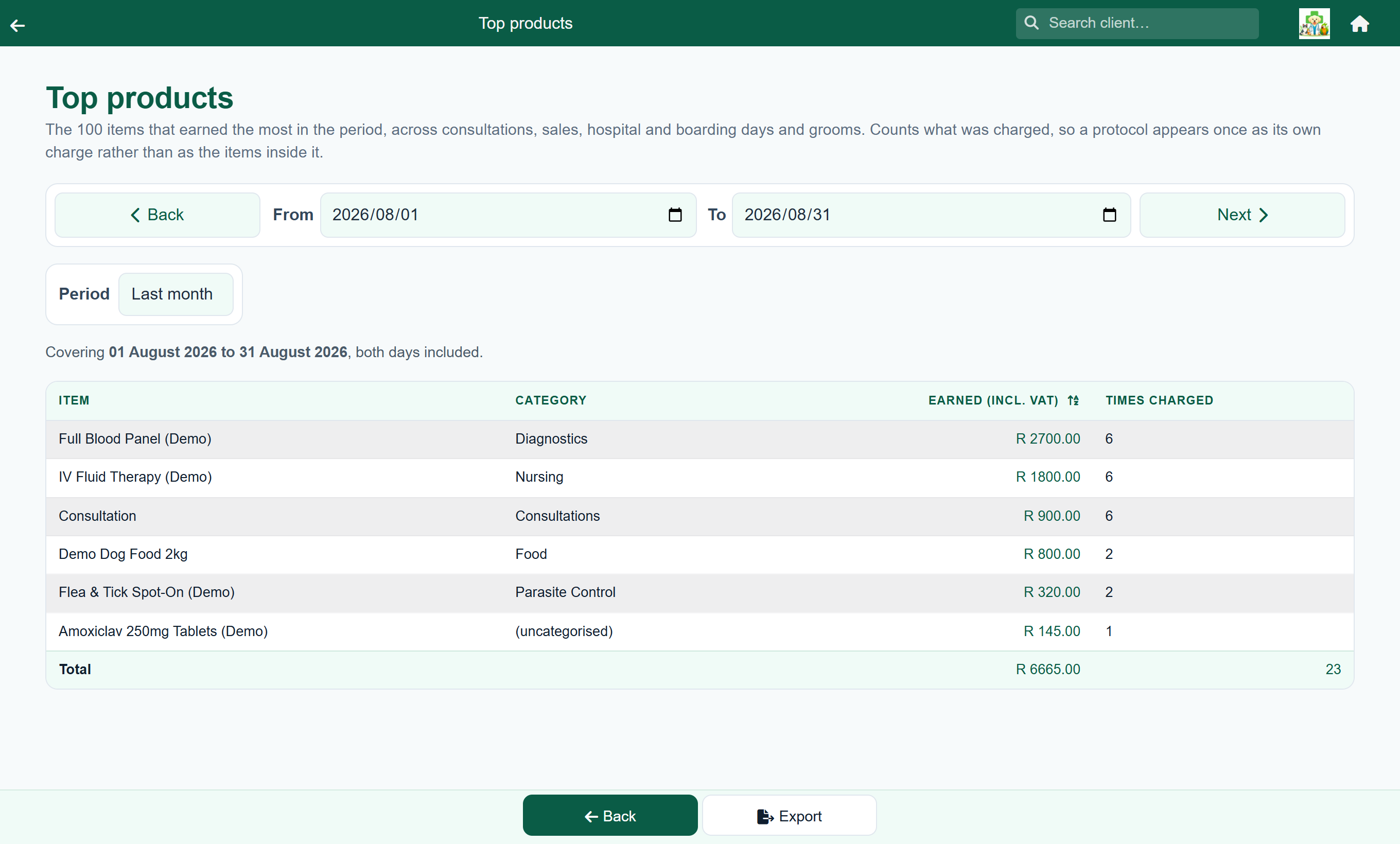
| Answers | "What actually earns us money?" |
| Reads | Every charged line, across every kind of visit, totalled per item. |
| Run it | Quarterly, and before a price review or a stock order. |
The hundred items that earned the most, with their category and how many times each was charged. It spans everything that bills: consultations, shop sales, hospital and boarding days, and grooms.
Monthly history#
Home›Reports›Monthly history
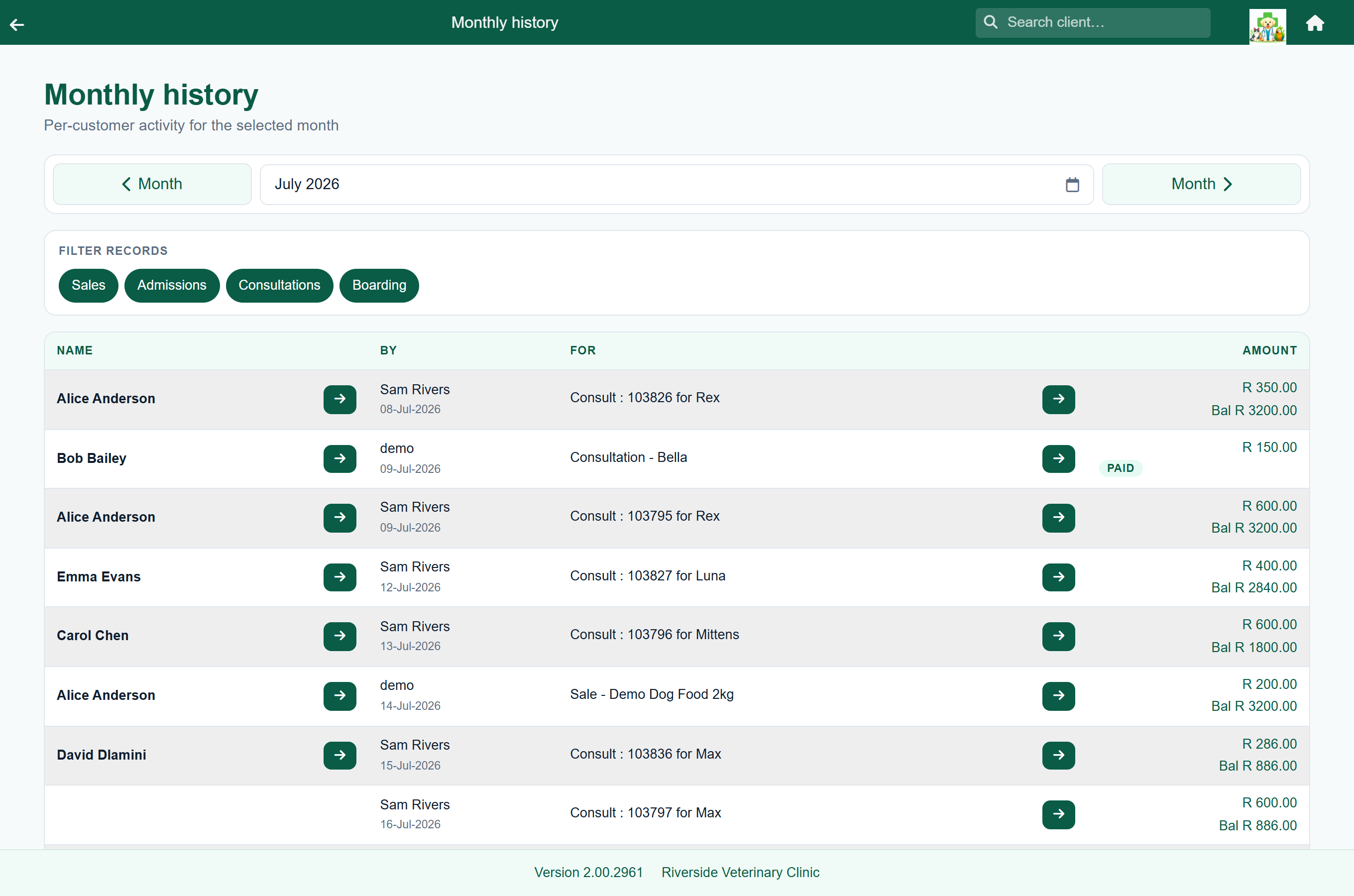
| Answers | “What did we invoice this month, and where did it come from?” |
| Reads | Every charge in the month — consultations, sales, hospital and boarding stays. |
| Run it | Month-end, and when you want to compare one month with another. |
It carries toggles for the four sources — consultations, sales, admissions and boarding — all on by default. Turning three off is how you answer “how much of last month was boarding?” without exporting anything.
Category detail#
Home›Reports›Category detail
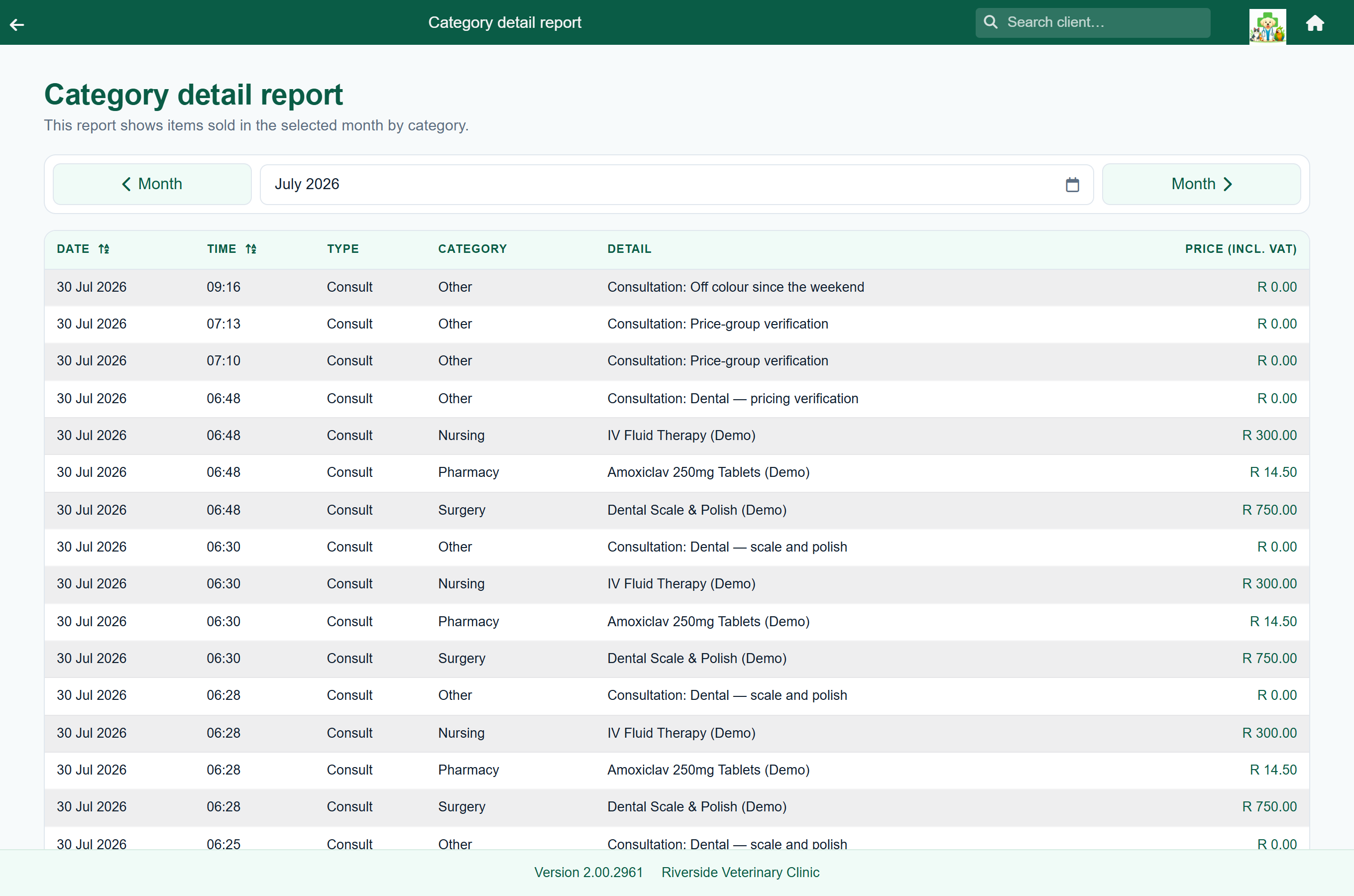
| Answers | “Show me every individual thing we charged for this month.” |
| Reads | Every invoiced line item, with the date, time, type and catalogue category. |
| Run it | When you need the detail behind a summary figure — or a spreadsheet for the accountant. |
This is the longest report: the category reports are this one added up.
It covers everything that bills — consultations, hospital and boarding days, grooms and shop sales. Lines are dated by when the work was done, so a five-day hospital stay appears on each of its five days rather than all on the day it was discharged.
Category summary#
Home›Reports›Category summary
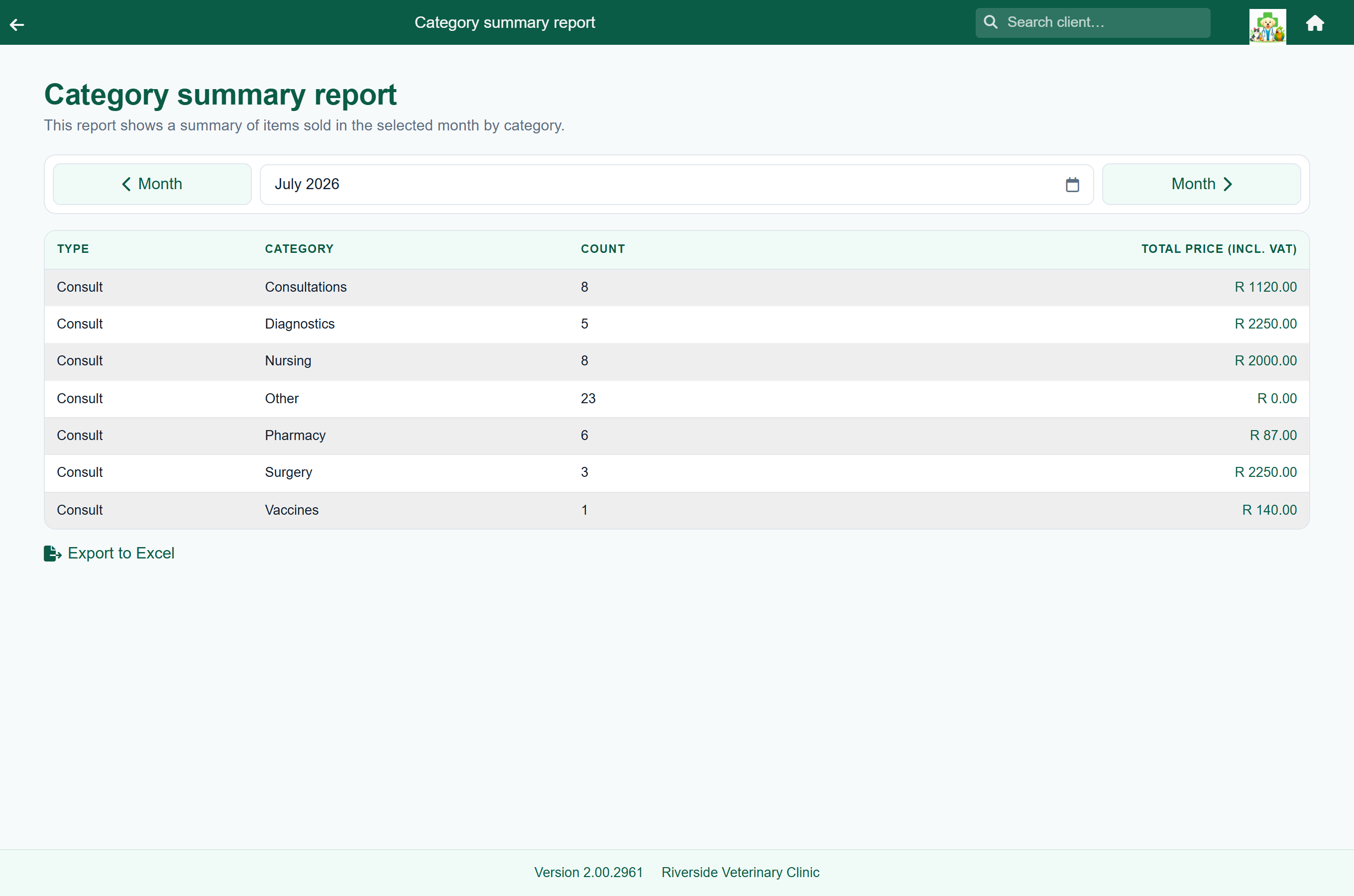
| Answers | “Where does our income actually come from?” |
| Reads | The same lines as Category detail, counted and totalled per category. |
| Run it | Monthly. It is the one to look at over several months in a row. |
Four columns: the type of event, the category, how many were charged, what they came to including tax, and a total across the bottom. The shop is counted alongside the clinical work. It is the shortest useful picture of a practice's month — surgery against consultations against food.
Activities#
Home›Reports›Activities
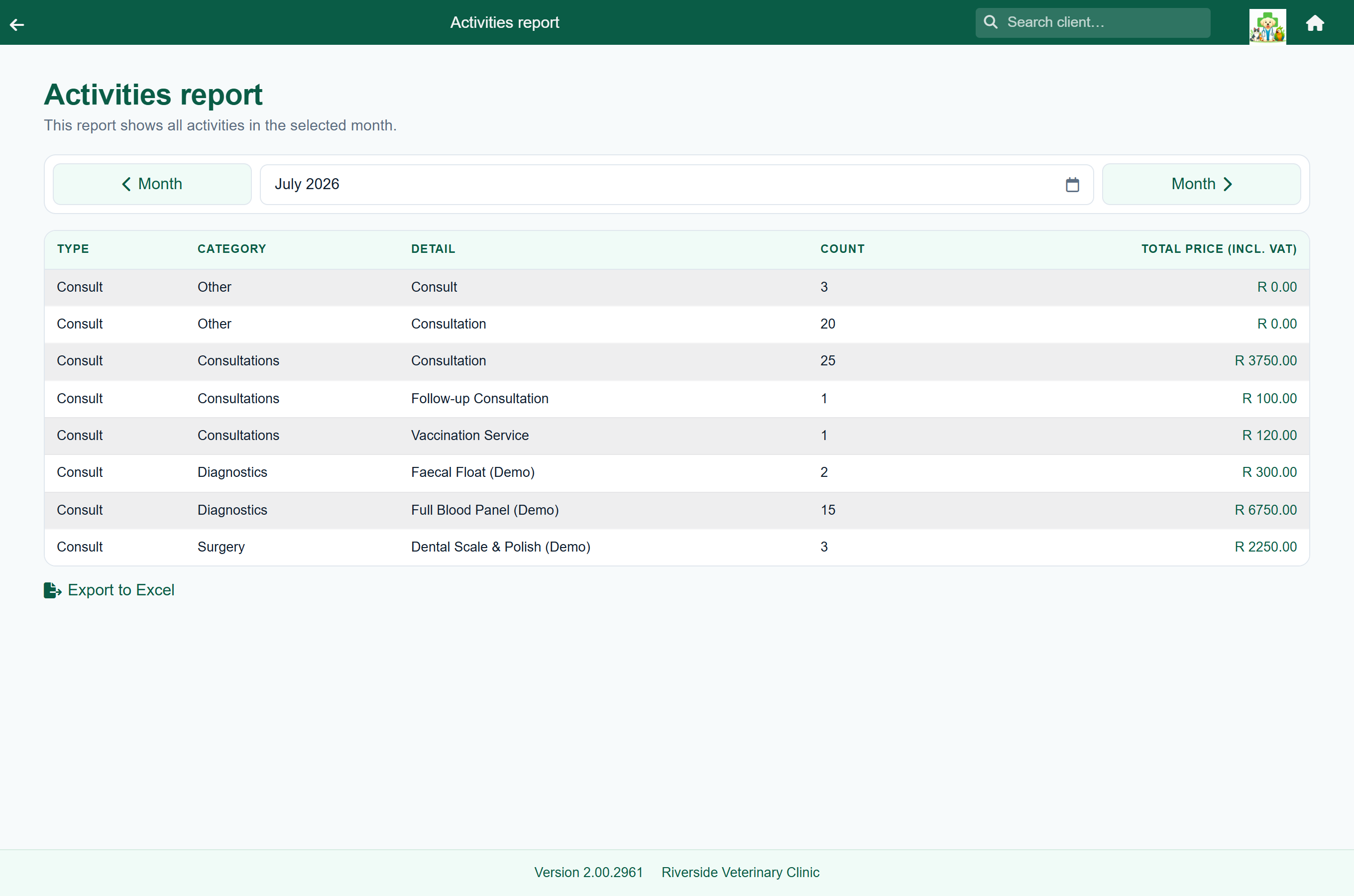
| Answers | “What did we do this month?” — volume rather than money. |
| Reads | Invoiced items again, but counted by what they were rather than what they earned. |
| Run it | Monthly, for staffing and stock planning. |
Consultations, procedures, vaccinations, dentals — how many of each. It is the report for “are we busier than last year?” and for deciding how many of something to keep on the shelf.
Stock used#
Home›Reports›Stock used
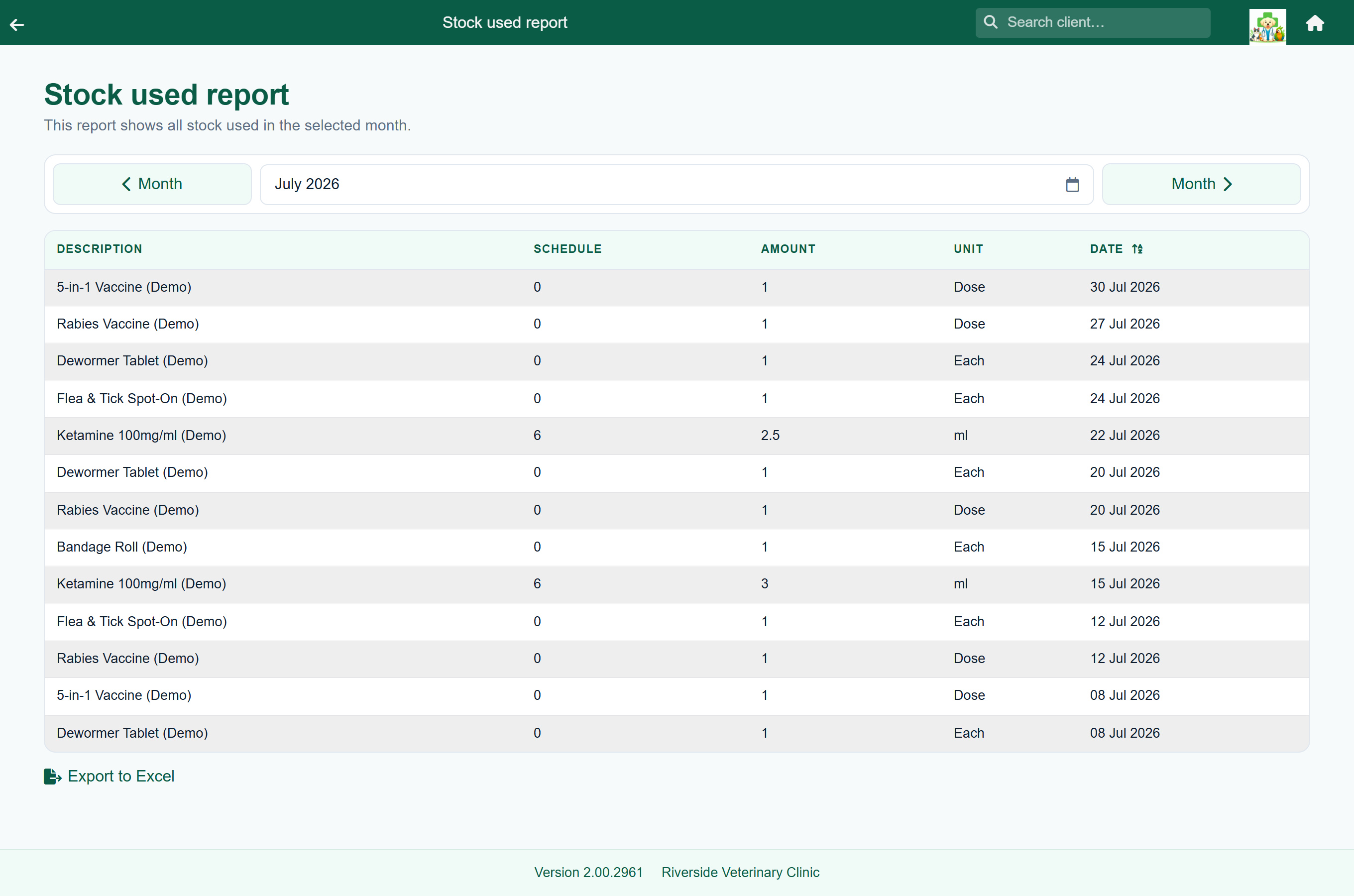
| Answers | “What did we get through?” |
| Reads | Stock movements dispensed to a patient. |
| Run it | Before ordering. |
Each line is one item used on one day, with its schedule, the amount and the unit. It shows you when something, such as a vaccine, is going out faster than you expected.
Stock value#
Home›Reports›Stock value
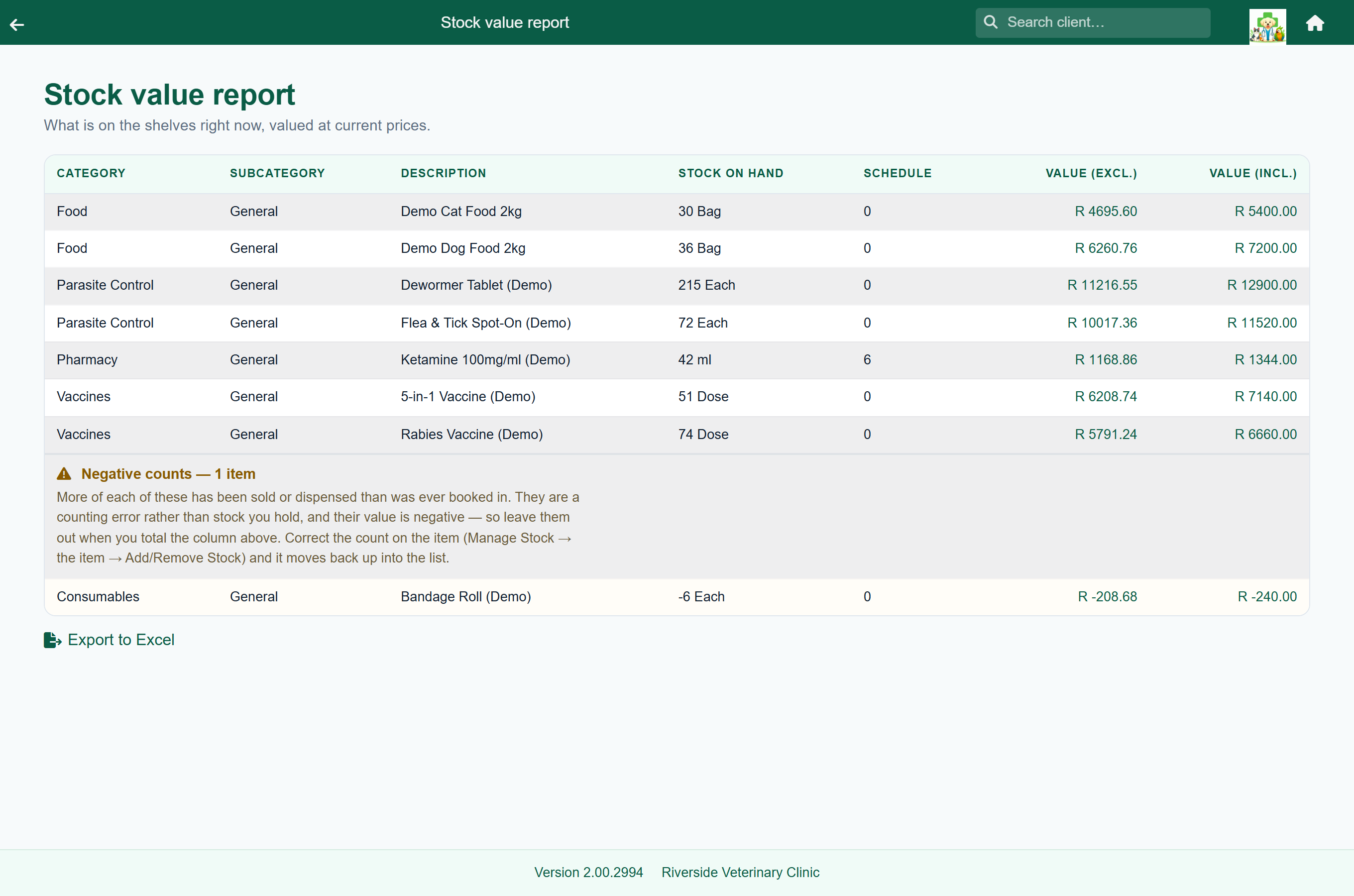
| Answers | “What was on the shelves worth, on this day?” |
| Reads | The stock ledger, replayed back to the day you pick, × the item's cost and selling price. |
| Run it | Month-end and year-end, for the accounts — or afterwards, once you know you need it. |
Every stocked item with its category, what was on hand, its schedule, the unit cost, the value at cost, and the value excluding and including tax.
Pick the day with the Day arrows or the date box. The report opens on today, and every figure is the position at the close of the day shown — so choosing 31 December values the shelves as they stood at the end of that day.
Items with none on the shelf that day are left out, including items added to the catalogue since. An item you have deleted since is still listed if you held it on that day.
An item with no price shows a blank value rather than being left out: FastVet has stock for it but cannot find its price-list entry.
Negative counts get their own section at the foot of the table, with their own total. A negative count means more has been sold or dispensed than was ever booked in. These rows are not part of the valuation above.
Expiring stock#
Home›Reports›Expiring stock
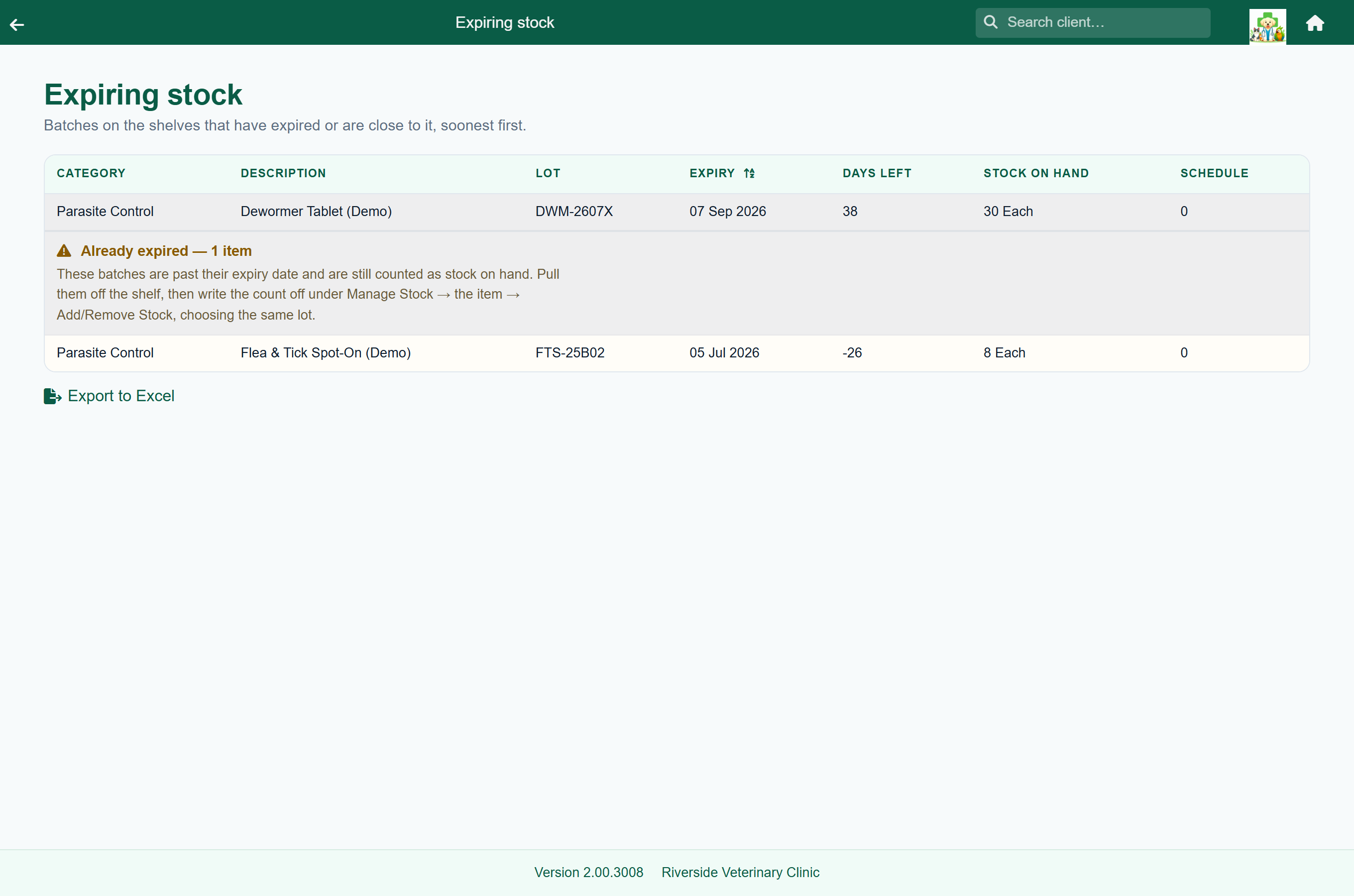
| Answers | “What is about to go out of date, and what already has?” |
| Reads | The lot numbers and expiry dates recorded when stock was booked in. |
| Run it | Monthly, and before you place an order. |
One row per batch, not per item — an item you hold three lots of appears three times. It shows the category, description, lot, expiry date, days left, what is on hand of that lot, and its schedule.
Already expired batches get their own section at the foot of the table. They still count as stock on hand, so take them off the shelf and write them off under Adjusting a count, choosing the same lot.
Stock to order#
Home›Reports›Stock to order
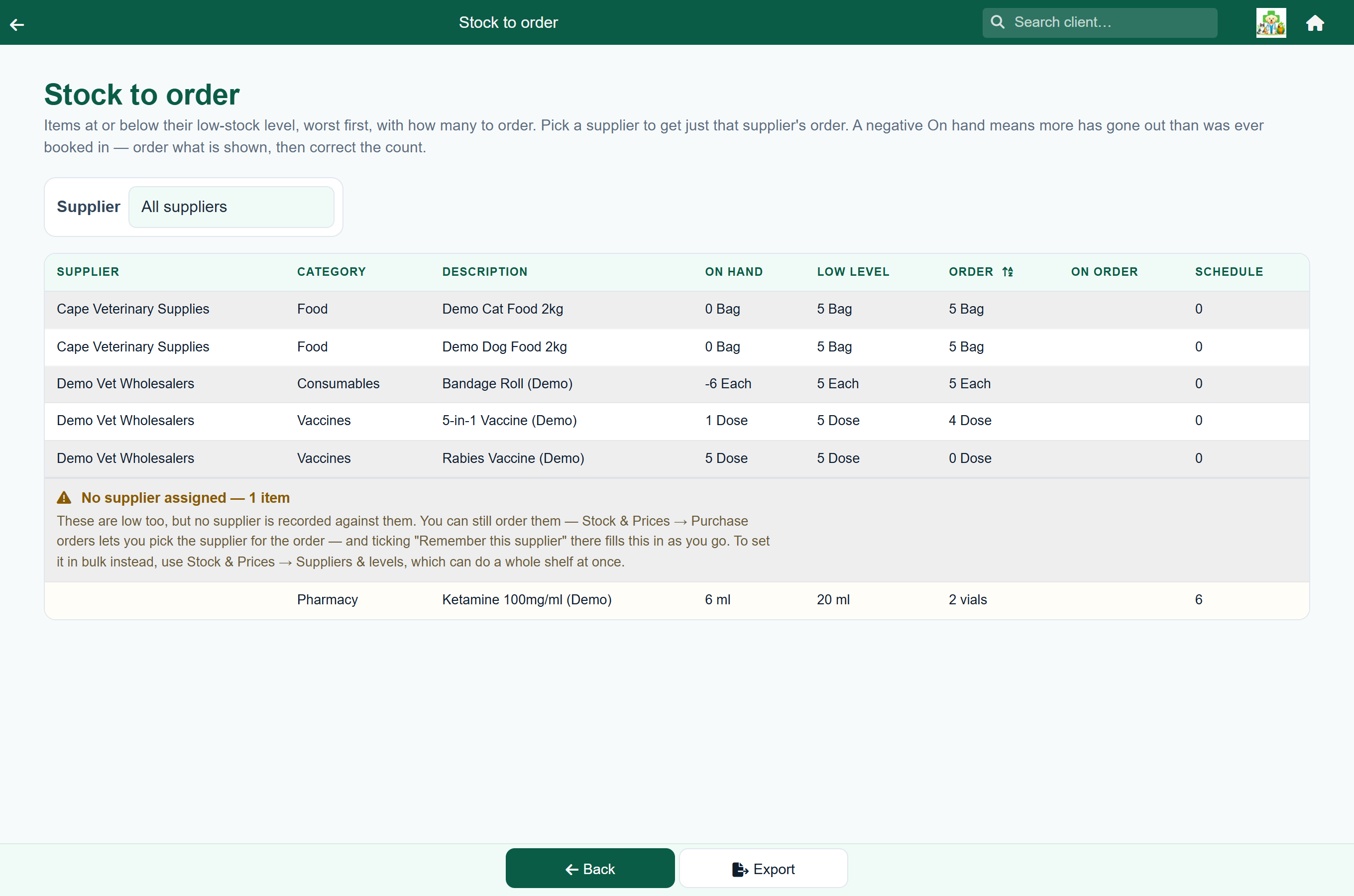
| Answers | “What needs reordering, and who do I order it from?” |
| Reads | Stock on hand against the low stock value set on the catalogue item. |
| Run it | Before placing an order with each supplier. |
One row per item that has fallen to or below its low-stock level. It shows the supplier, category, description, what is on hand, the low level itself, how many to order, the quantity already on order, and its schedule. The biggest shortfalls come first — the size of the gap, not how urgent it is.
Pick a supplier in the box above the table to see only that supplier's items. Leave it on All suppliers to see everything that is low.
The On order column is what you have already asked for on purchase orders sent in the last two months. It is not taken off the Order column, because FastVet does not know the delivery has arrived until you receive it. Read the two together and decide.
A negative On hand is a counting error. It means more has gone out than was ever booked in. The report works the shortfall out from zero, so an item at −6 against a level of 5 is short by 5, not 11. Order what it says, then correct the count under Adjusting a count.
The Order column is what to put on the order. It is the gap between what you hold and the low level, rounded up. An item exactly on its low level shows 0 — it is listed as a warning.
Where you have said how an item is bought, the order is in packs. An item counted in millilitres that arrives in 100 ml bottles and is 350 ml short asks for 4 bottles, not 350. Set that up under How you buy it. Items you count in the same unit you buy them in need nothing extra.
Items with no supplier get their own section at the foot of the table. You can still order them from Purchase orders, where you pick the supplier for the order. To record a supplier on the item, see Saying who supplies an item.
Schedule drugs#
Home›Reports›Schedule drugs
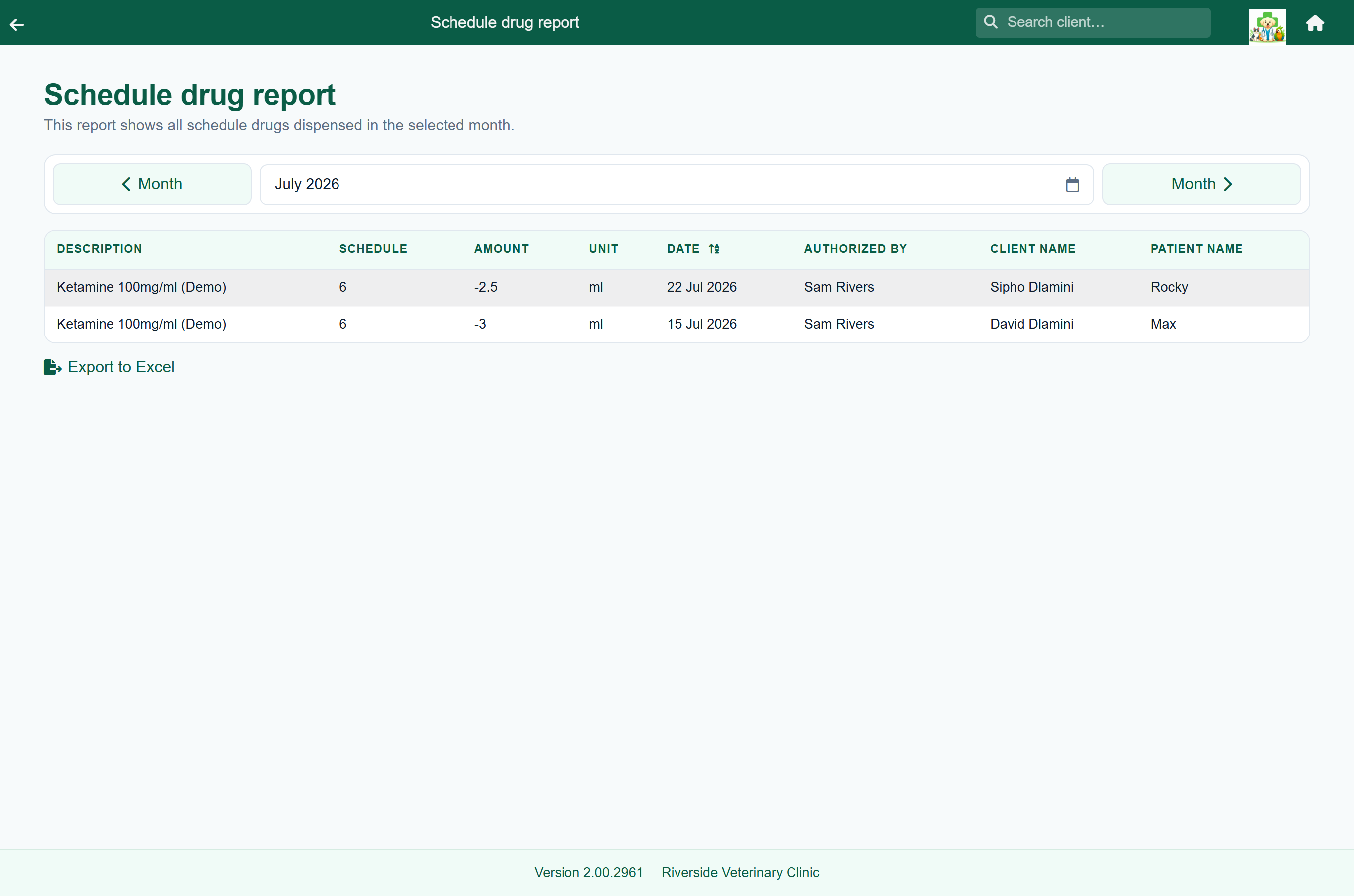
| Answers | “What controlled drugs have moved, and can I prove it?” |
| Reads | Stock movements of items whose catalogue Schedule is 5 or higher. |
| Run it | Whenever your register is written up, and keep the export. |
Each row is one movement: the drug, its schedule, the amount and unit, the lot and its expiry, the date, who authorised it, who dispensed it, and the client and patient it went to. Dispensing shows as a negative. Movements with no client — stock booked in, and counts corrected up or down — show against ** Stock Bought / Updated **.
Lab results#
Home›Reports›Lab results
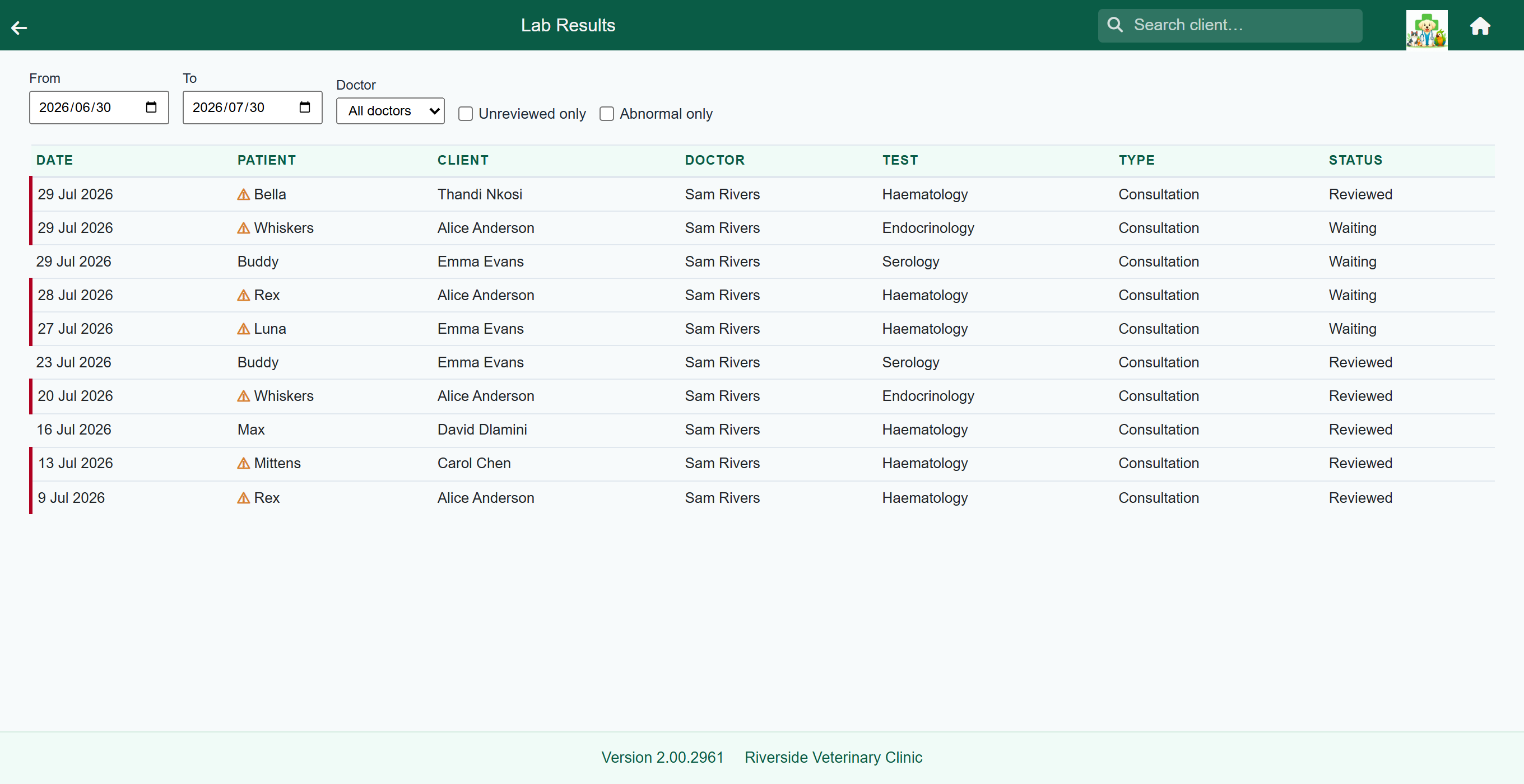
| Answers | “What lab results have come back, and which are abnormal?” |
| Reads | Returned lab results over the period, with the patient, client, doctor, test and review status. |
| Run it | When you are checking results across the practice. |
Narrow it by doctor, or tick Unreviewed only or Abnormal only. Abnormal results are marked with a warning sign. For the results waiting to be reviewed day to day, use the inbox — see Lab results.
Email history#
Home›Reports›Email history
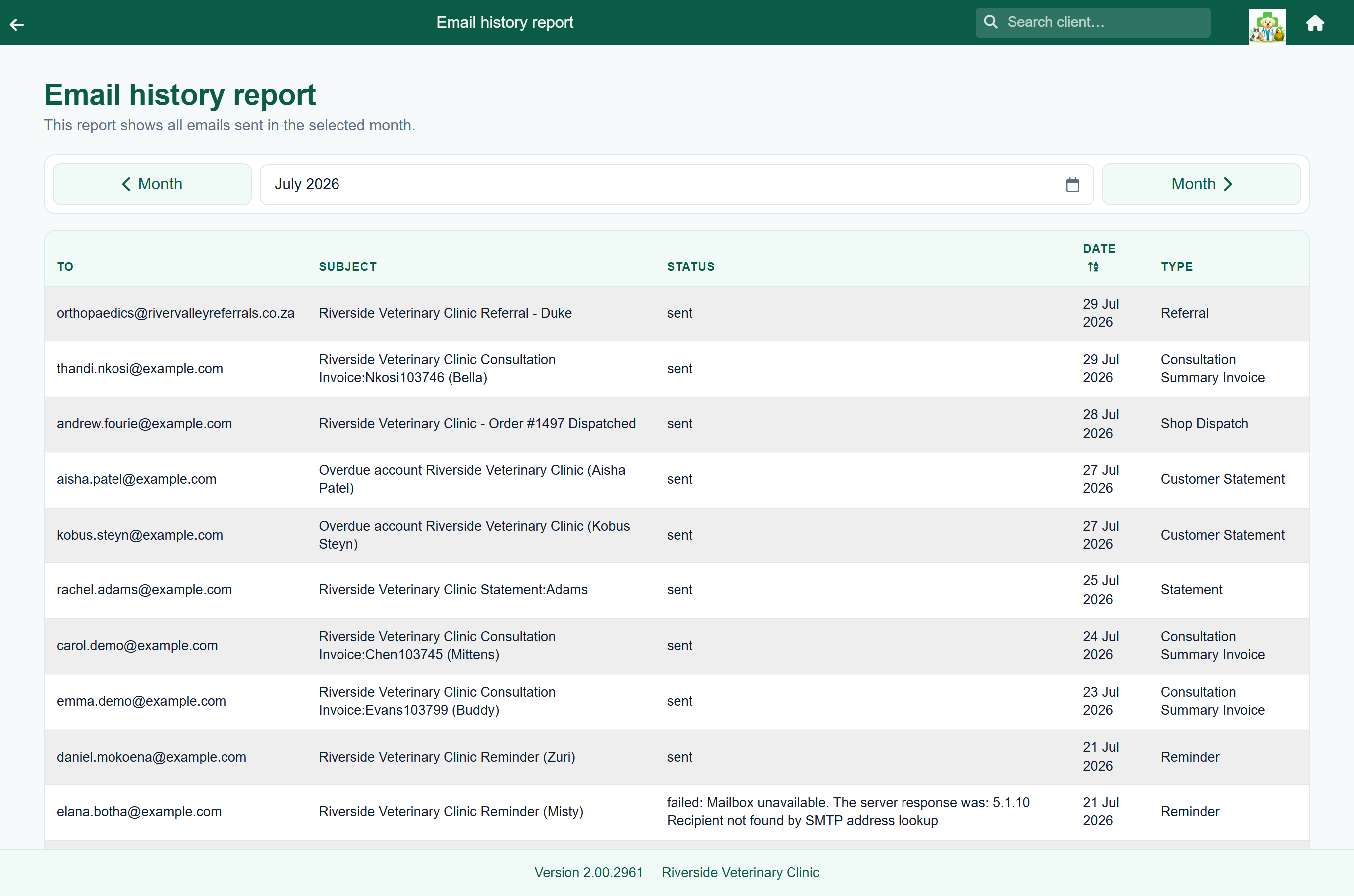
| Answers | “Did that client actually get their invoice?” |
| Reads | Every message FastVet handed to your mail server, successful or not. |
| Run it | Whenever a client says they were never told — and once a month to catch bad addresses. |
The address, the subject, the status, the date and the type of document. A status of sent means the mail server accepted it; anything beginning failed: carries the server's own explanation, usually a wrong client address or wrong mailbox settings.
The report is covered in full, along with the templates and switches behind it, in Templates & letterheads.
Exporting to a spreadsheet#
Every report exports. Export is in the footer. It downloads an Excel workbook named after the report and its date — for example Account book 2026-07-31.xlsx or Stock value as at 2026-07-31.xlsx.
Payments received has two buttons instead: Export summary for the takings by tender type, and Export detail for every payment on its own line.
Money columns arrive as numbers, so they add up in the spreadsheet. Amounts with a unit — 4 ml, 10 Each — stay as text.
Export is greyed out when the report has nothing in it.